Showing posts with label Equipment. Show all posts

Monday, May 27, 2019

Initial Training II

Sammi and Ella staked-out

At 16-weeks Sammi and Ella are coming along nicely. Most recently, both pups have been introduced to the stakeout. Initially they didn't care too much for the stake and chain, and its restraint; they pulled at it, bit it, flopped-around trying to get away from it, whimpered, cried, and made a big fuss. After they settled-down a bit, I fed them, and their view of the stakeout changed a bit. I've had them on stakeout four times, each time with six to eight other dogs; the two pups in the middle, with the older dogs on each side. I think the company of other dogs is good when making this transition from "puppy freedom" to a world of more obedience.
Both are still outfitted with their fixed checkcords and have been introduced to the full-size version with which I've begun their initial work on the "here" command. Both pups new what "here" means before their introduction to the checkcord, but now I'm starting to enforce the command, making sure that they come to me whenever I call them.

Sunday, March 10, 2019

Check Cords

Check Cords
I made these four check cords in about fifteen minutes out of some old, frayed, climbing rope; unsafe for it's original purpose, but perfect for yard-work with a dog. A 20-foot length of rope, a brass clip, and a bowline knot and you have a functional piece of equipment. I don't check-cord my dogs into birds, however I do let them a drag a rope around the bird-field. I use check-cords for teaching my pups to bend and stay to the front, to put a "here" in them, in heeling and whoaing and backing drills, and other yard work.

Friday, February 22, 2019

Staked-out

Stake-outs are a great option when weather and ground conditions allow for a good spot to get the truck off the road; in the late season a nice dry wide-spot is often hard to find. The stake-outs give dogs that would otherwise be crated an opportunity to stretch their legs and lay in the sun, recover from an earlier hunt, relieve themselves, and get watered-up and fed. The stakes should be kept far enough apart so that dogs can't get tangled in each others chains; this could be disastrous, if not deadly. Each of my stakes has a 30-inch chain on it, and I generally space the stakes about 7-feet apart. With that chain length, and that distance between stakes, dogs can generally just touch noses or paws.  Dog stools are picked-up as generated, which generally occurs within the first ten minutes of being staked-out after the morning ride to the grounds. Bring along a shovel to scoop the poop, and to fill any holes your dogs may dig while stake-out.

Sunday, February 11, 2018

Gear

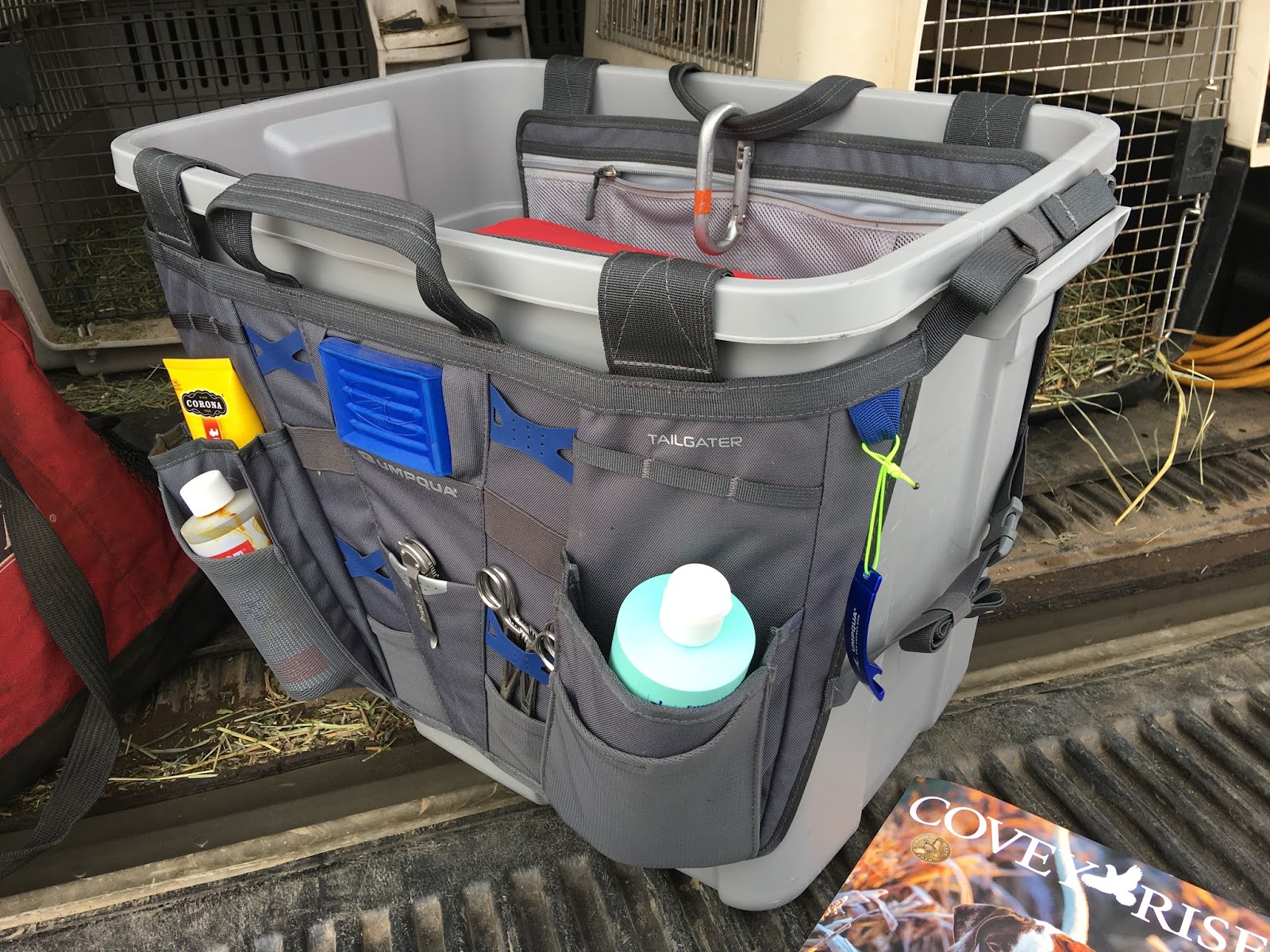
I stumbled across this handy item while perusing a fly shop in Bend, Oregon, last fall. The "Tailgater" is made by Umpqua and fits around and inside a Rubbermaid Roughneck (18-gal) container. The Tailgater is designed with the flyfisherman in mind, but I found it perfect for packing around all the gear and other necessities associated with a day or more spent bird hunting or dog training. The assorted pockets of the Tailgater are situated both inside and outside the Roughneck, and are perfect for storing a number of items including medical aides, e-collars, batteries, whistles, reading material, you name it. The heart of the container is ideal for storing water jugs, dog feed, bowls, shotgun shells, any number of the larger items you typically tote around on a hunt or training session.

Sunday, January 25, 2015

A Willys for my bird dogs

I have, for many years, been the owner of a 1947 Willys CJ2A. I bought it in the late 90s to haul dogs on bird hunts and to take with me on occasional big game hunts. 


On an elk hunt on Day Ridge, Oregon
Inevitably, one day it 'failed to proceed'. I thought it was the fuel pump, but found a new replacement didn't help. Decided it was dirt (or rust) in the fuel lines or perhaps a bad carburetor. SO pulled the fuel lines and carb and sent it to be rebuilt… parked the Jeep and covered it with a tarp and got busy with other stuff. A few years later I got back to trying to repair the old buggy. By this time there were still more problems. It wouldn't turn over.  Pulled the head… had a piston frozen in the block. 

Now the fun began. Looking it over, I decided that it needed some serious attention and I began dismantling it to find and cure all the ills. In short order I was involved in a frame up restoration. Stripped it down and examined all components to see what could be used, fixed, or needed to be replaced. That was over a year ago. Now the old Willys has a newly rebuilt engine, transmission, transfer case, axles (with a full floating rear end with locking hubs), new brake system, new suspension, tie rod ends, and a rebuilt steering box. I am toiling to get the body repairs (read fixing the rust) done. This is what I am hoping to get to - a funky, but fully functioning, flat fender Willys classic…


Wednesday, December 31, 2014

Gear

My two favorite pieces of upland bird gear are my Arrieta 577 double and my Wing Works vest. Beneath the vest I'm wearing a Filson moleskin vest, a Royal Robbins knit longsleeve and lightweight polyester thermals. Headgear this day was a thinsulate camo beanie by Gamehide. Gloves are a lightweight Browning shooting glove. Up top I like clothing that breathes, wicks moisture, and dry's fast. Trudging uphill in chukar country can make you sweat, even in 20-degree weather with a headwind. I can pack a lightweight fleece in the Wing Works vest, put it on at ridgetop, hunt downhill and stay warm.

Tuesday, March 12, 2013

How we roll...

I have been refining my hunting truck set-up and thought I would share the latest iteration. I still have the 4 dog topper and will use when needed, but I liked the idea of something a bit more flexible. 

My truck is an older (2001) F350 that does great towing my Airstream or my fishing boat. But I needed to add a few things to make it convenient for hunting trips. 


As a useable base, and to provide easy access to the contents of the truck bed, I installed a full length, roll-out Bed Slide that is 48 inches wide. On top I put an ARE shell with swing up side windows. The windows provide access to a Line-X coated ply box that sits within the bed rails - over the forward part of the bed. 

On the Bed Slide I fitted a poly 35 gallon potable water tank (48" X 18" X 10") and a small electric pump. This provides a means to carry plenty of water when I need to refill the tank on the Airstream or when camping out of the truck or if I just want to douse a dog.

My excellent friend and fellow blogger, Pete, made a very nice gun and 'stuff' drawer that fits on one side of the Bed Slide - leaving room for a storage box or a sliding tray for my Engel 45L fridge/freezer. Pete built it with 'double decker' drawers that occupy the center area and, somehow, boxes of sixteen gauge loads fit exactly in the top drawers. Thank you, Pete! The wire dog crates go on a piece of carpet on top of the box - ratchet strapped securely to the Bed Slide.

This works out to be a pretty good way to carry a couple bird dogs, four guns, a generous amount of ammo, a ton of hunting crap, a lot of water and nearly anything else you need to haul along.

Tuesday, November 30, 2010

A truly miserable dog

Here's Rosie, looking very unhappy with her new footgeat. But she got used to them quickly and the Lewis boots did the trick - no foot problems.

Thursday, August 12, 2010

Gun X training pistol


The Gun X training pistol is a recent entry into the market that has generated a little discussion in the last few months. I've had the chance to see and use one the last couple of weekends. My impression is that it's very well made and to this point seems quite reliable. It feels much more like an NEF than an ALFA with the overall weight between the two. If I hadn't recently purchased an ALFA, I'd have one of these in a minute.

See http://www.dogsafield.com if you're interested.

Friday, October 23, 2009

New dog topper


Shortly before I left for Nebraska in mid-September, I completed my dog topper project - a four-holer with room for extra gear. Above photo - Ted is modeling on the tailgate of the Ford with the completed topper in place. This is a Ford F350 crewcab with a short (6' 8") bed. 

This topper was inspired by the ones made by Bob Welch of WingWorks in Hailey, ID. Instead of the aluminum sheet that Bob used, I chose to make the interior of Baltic birch plywood, which was then sprayed with Line-X bed liner. This made an inexpensive, durable and stable solution to floors and dividers.

Here is Tommy trying out his new digs. He seems dubious, but all the dogs are happy to travel on warmth and comfort with hay bedding. The boxes in the bed of my F350 are each 24"W X 32" L X 27" H and the floors are insulated with 1" of styrofoam sheet under the Line-X coating - this has proven very successful.

I will make a PDF of rough plans and some photos when I get back from Saskatchewan. More updates to come in about a week.

Monday, August 31, 2009

The last word on Garmin Astro use in Canada

Craig over on Chiendog Blog has done further research on the Garmin Astro and its use in Canada... check here for enlightenment.

I am going to Saskatchewan this Fall, and will be INFORMED on these matters...

Wednesday, June 17, 2009

Note on the Garmin Astro in Canada

Use or possession of the Garmin Astro in Canada is forbidden by federal law. The bandwidth used by the Astro has been reserved for Canadian government use. If you are heading to Canada, leave the Astro home. No sense in irritating the Canadian government, is there?

EDIT: Craig over on ChiendogBlog has done the research (he's a Canadian, so they are more likely to talk with him...) regarding the exact nature of restrictions on the use of the Garmin Astro in Canada. Check it out HERE. Thanks, Craig!

Sunday, June 14, 2009

Summer conditioning


It is a long drive to my training grounds. But I do live very near a terrific trail system, and have been running dogs there on checkcords (no off leash dogs, and no four-wheelers, dammit). My usual loop is about 6 miles.  

I have contemplated using my mountain bike to road dogs, but two dogs and a mountain bike = scrapes and scars. While thinking about a simple way to road at full running speeds, I searched up this dry-land mushing cart. Built by Arctis in California, this cart or something like it would neatly solve my problem. 

Wednesday, May 27, 2009

Details on Bob's Dog Box

Bob Welch of WingWorks provided some additional photos of the construction of the dogbox/fiberglass cap that he built. He also sells the complete doors shown in the photos at a reasonable price. He has promised some drawings, too.

Here is the rear view with the back wall removed, allowing a look at the interior of the rear two boxes. Note the open rubber matting in the bottom of the boxes... this and an armload of grass hay keeps the dogs up off the bare, cold  aluminum floor. Easy to clean, too.

Below is the view of the internal partition showing the careful scribing and cutting for a close fit against the carpeted interior of the ARE shell...

This is the rear wall divider removed. Note the 'L' bend at the bottom that allows for attachment to the floor of the kennels. Bob built with 'L' bends and angle brackets with bolts and Nylock nuts to make assembly and disassembly quick and doable at home.

I am assembling parts and ordering an ARE shell for my pick-up. Hope to have one like this built in a month or so. I'll post some pictures.

Thursday, May 21, 2009

New F350

My old Ford Expedition is getting long in the tooth with 185,000 miles under it. It required two stops at Ford dealers (Havre, MT and Lewiston, ID) last Fall while on the road. So today I bought a 'like new' Ford F350 Super Duty crew cab turbodiesel (7.3L) with 65K miles to replace the Expedition as my hunting truck. It has all the whistles and bells that the Expedition has, but has decidedly more life in it.

Next on the agenda is a capper like the one that Bob Welch built, and outlined in the post earlier. Then I will go to work on the Airstream getting ready for Fall.

Wednesday, May 13, 2009

Bob builds a dog box


Bob Welch of Hailey, ID sent me these photos of a dog box he has recently completed. Starting with a 'blank' ARE fiberglass shell and a pile of sheet aluminum, he crafted a very good looking and utilitarian topper for his F150. 

Since I am in the hunt for a 'newish' Ford F250/350 7.3L turbodiesel truck, I have been quizzing Bob for more information. Hopefully he will forward some diagrams or sketches along with some construction details.

BTW, the "pod" on the top of the camper is a pop-up roof top camper, complete with 3-1/2" thick mattress and electric light. Bob likes his comfort.

EDIT -- Added the photo of the rear view with the tailgate open. Lots of possibilities for this design... water tank, full drawer system, aux battery, pop-up remote control roof vent...

Thursday, March 12, 2009

About e-collars


This is perhaps the second most popular dog training tool, second only to the check cord. A recent thread on a popular BBS was a discussion of experiences people had with e-collars. I thought I might repeat myself here...

I have become circumspect in the use of e-collars over the past several years, based on close observation of my own setters in trials and hunting.

I never put a collar on a dog under one year old, except for trash breaking.

I never nick a dog on birds anymore. I have seen dogs that anticipate the nick, and tense up and lower their front quarters when they expect that they MIGHT get nicked. This is not good for style around birds. I will correct the dog verbally and by hands on methods. I may go back to a check cord at these times.

If I can teach with a checkcord, I prefer it. I do use the collar to re-enforce training. I use the lightest setting I can still get compliance with.

By the time my dogs are three years old, they do not need the collar... I am moving towards running my dogs without e-collars once they are well trained. I think I get better performances in the bird field without a collar.

If I was a professional trainer, I might use the collar a lot more and earlier, in order to train more dogs, faster. But I am not in a hurry, and REALLY dislike the idea of moving a dog to breaking STWS before they are totally ready for it.

Patience is the best training tool.

Wednesday, December 31, 2008

Garmin Astro -technology and tradition collide

As is inevitable with new technology (what Ester Dyson would call 'disruptive technology') the collar mounted Garmin Astro tracking unit is stirring a lot of discussion and head scratching in field trial circles.

Hunters love it. I love it. But field trialers are of mixed opinion. So here is the current situation as I understand it - along with my opinion and a few choice observations from others.

The major field trial organizations - AFTCA, American Field and AKC have all established maximum weight limits for electronic tracking aids. The reason for this is that they are concerned about collar mounted devices that would emulate the weight of an electronic training collar, which is banned for use in field trials. 

These organizations have recently weighed in with decisions about the use of the Garmin Astro in the events that they sanction.

AFTCA - I spoke with Linda Hunt, Secty of the AFTCA, yesterday. She said that they will not allow the use of the Garmin Astro in their sanctioned amateur trials due to the receiver and collar exceeding the established maximum allowable weight. When asked if she had heard any philosophical arguments against the use of GPS tracking collars, she said no, it is just the issue of weight.

American Field - The AF has decided to allow the use of the Garmin Astro in OPEN stakes. The AFTCA and AF are usually closely aligned on these issues, and it is expected that the AF and AFTCA will try to 'get on the same page' during the annual Summer meeting of the Trustees.

AKC - Has decided against allowing the Astro in their sanctioned trials, stating that the weight exceeds their allowable limit.A website has been established to petition for a reversal of the rulings of both the AKC and the AFTCA: Astro Petition website.

Meanwhile, the new field trial website/blog, Strideaway, has weighed in with an editorial - The Best of Intentions, the Worst of Results. In the editorial the authors (unsigned, but I assume the primary blog authors - Chris Mathan and Mazie Davis - wrote the piece) put forth the idea that the GPS based device, beyond opening the door to abuse, would somehow undermine the sovereign principle of subjective judging. 

My response to the Strideaway editorial is that, minimalism and 'purity' would best be attained with just grounds, wild birds, dog, shoe leather, and handler. I understand the thrust of the argument, which is motivated by traditionalism and concern over the possible use of technology. 

Planted birds,radio telemetry tracking collars, 4 wheelers, mounted scouts ... all these have made a departure from 'purity' and have added complexity to the game. Limiting the employment of technology at this point seems to be a little like acceptance of the idea that one can be a little bit pregnant.Is a GPS locating collar somehow less pure than a radio tracking collar? Does it really threaten to compromise judging or ethical handling? It's up to the club, participants, and the judges, isn't it? 

I posted this thought on the Coverdog Trial BBS, Chris Mathan wrote: 

I don't know how much judging you do Mike, but try if you can to put yourself in this position:

You have just judged an all-age championship with a large entry. You looked at many fine performances. You and your fellow judge made your decisions based on...what judges have based their decisions on since the beginning of field trial history. After the trial, an owner of a dog, make it three owners, march over to you, all three with their GPS receivers in hand. One guy's dog, according to the data, ran 700 yards (official all-age range!) to the front, (beautiful pattern on that LCD screen) and had two finds, the other two guys then show you their dogs' data and all three ask why their dogs didn't win. They are pretty mad and decide to post all this stuff on the internet on their favorite chat board. Do you think you will take the next judging assignment you're offered?

The editorial goes to some length to distinguish between the two technologies. The GPS collar can and will be matched to any number of hand-held devices which will be on even if the receiver the judge has is turned off. How could that be prevented? They are small and will get even smaller and more sophisticated in a short space of time. The exactness of the data and size of the handheld receiver will certainly make it easier if someone wants to cheat while scouting but the key issue is that it will gather data that should not be gathered in the first place. The editorial was written and posted on Strideaway because, regardless of what your feeling is about the GPS, the issue should be carefully considered. The GPS is a huge departure from what we currently use to safely retrieve a lost dog. 

Frankly, if I were judging and someone showed me a Garmin Astro track of their dog's performance I'd disqualify their dog and toss them out of the trial... it's illegal to use an electronic tracking device in a trial. It may only be employed after a dog is declared lost and is 'out of judgement' and the judge is the only person allowed to carry the tracking unit.

A few sample responses in the same thread:

"The answer to the 3 wise men would be simple. Maybe your dog ranged further, or maybe it was faster but I could hardly look at your dog as It was braced with the winner. The winners running style, style around game, and everything about it totally outclassed the dogs you wise men are complaining about. Oh bye the way I will be judging again at Blankity Blank. You can stay home if you wish, as I will use my discretion again. And if the same thing happens, results will be the same." - J.M. 

"...I agree that the use of GPS collars does raise some questions, and they do need to be addressed. I'm not even convinced that the GPS units should be allowed... But let's talk about the realistic issues that will arise, and not theoretical ones born out of misunderstanding of both the new and old technology. And while we are talking about real issues, I find it sad that the editorial fails to address the health and safety of the dogs we are running. The health of the individual dog is paramount to the theoretical health of the sport, is it not? " - D.Q.

People objecting to the use of GPS technology have not mentioned the main reason to employ such a device - the health and safety of our dogs. A number of dogs have been lost at trials - veering off course and crossing busy roads and being killed by automobiles, or by simple being lost and never retrieved. Anything that prevents this tragedy should be welcomed.

Field trials have a 130 year history in the United States. Tradition is a good thing, but must not blind us to aids that will help guarantee the safety of our dogs. There will be more said on this subject before the dust settles, but I believe that GPS technology will be allowed by all three major sanctioning bodies, and we will wonder what the argument was all about.

Tuesday, December 23, 2008

Traveling with bird dogs


Many hunters and trialers drive thousands of miles a year with their dogs. I am no exception. Some of you might find something in my experiences that you can put to good use. Some of you may have different ideas and practices – if so, please share them.

I travel in either my Ford Expedition or my Toyota Landcruiser. I sold my last pick-up truck some years ago. Traveling with dogs in an SUV has some good and bad points. Good points are that I can keep my dogs warm in cold weather and cool in hot weather. I can keep a close eye on them in the event of a problem. Bad points – dog farts, and space constraints. One requires power windows, the other careful organization.

Pete Houser built a drawer system for me to hold guns and small gear (thank you, Pete!) in the rear portion of the SUV. Guns, ammunition, stake outs, dog gear and tools are handy from the tailgate without digging through gear or moving anything.

Every dog deserves a place of his own where he is protected during emergency maneuvers and feels comfortable. Dogs should be crate broke when they are puppies and will learn to love riding in their crates. The crates go on the top of the gun box. This puts dog crates up high enough that they limit the rear view significantly. My answer is to employ wire crates that allow me to see through to the rear window. They also allow the dogs to see out and they fold up for easy storage when not in use. While traveling (and for most of the season) the crates are secured to the gun box by a pair of ratchet straps so they will not shift or tip over.

For water, I carry a 20 litre water jug made of heavy plastic – a bomb proof product from Scepter of Canada. It is similar in design to a fuel jerry can, but made of plastic rated for potable water – no weird chemicals in the water. The can sits neatly on the floor at the rear between the gun box and the side of the truck. After trying many different designs and mopping up leaking water from lesser products, I have settled on this can as the best. I also carry a stainless water dish for each dog. Offer your dogs water at each rest stop.

I have seen a number of watering systems made of PVC pipe. There are possible risks using this material... PVC should be used for cold water only, or venting. CPVC can be used for hot and cold potable water supply. Connections should be made with primers and solvent cements as required by the plumbing code. No sense in putting harmful chemicals into your dogs.

Dogs need regular breaks to stretch and do their business. I stop about every three to four hours. The interval should be regular so that the dogs can anticipate when a stop will occur. When traveling, I recommend that you avoid highway rest stops with 'doggie areas'. These spots are used by many travelers and are a vector for disease pathogens. A lonely stretch of highway with a wide spot to park is a better bet.

A check cord is essential when you stop for a travel break. A 15' or 20' check cord with a quality brass swivel snap should be handy whenever you open the tailgate. I never let a dog out of his crate without a check cord, leash or other restraint. They know this and are trained not to step out of the crate unless they have the check cord secured to their collar. There are too many things that tempt a dog that has been confined for several hours. Hazards include traffic, barbed wire fences, road killed wildlife, and rubbish (you name it... from broken bottles to used disposable diapers!) along the road side. Maintain positive control of your dog during travel stops.

Saturday, November 22, 2008

A gift from a friend

I first met Gary Goudy in 1972, when he was living near me and starting to develop considerable skill as a stock maker. Since that time we have been fast friends and hunted together in the Western US and Canada. He has stocked a number of guns for me, and I have learned a great deal from him. There are very few friends that I value as highly as Gary.

Gary has extraordinary skill with his hands. He says, "My brains are in my hands." I dunno, but he can make a saddle, carve, checker and finish  an exquisite gunstock, and does wrought iron work 'on the side'. He built an beautifully done VW 'dune buggy' with a dashboard of hand carved English walnut. 

I recently visited Gary at his home in Dayton, Washington and we had a day hunting pheasants together.  At that time he showed me some leather braiding work that he was doing for fun, and it was extraordinary and imaginative. He said that he would like to braid something for me, and I said I'd like a whistle lanyard. He sent an e-mail today with photos of the lanyard he made for me - a real beauty. Thank you, Gary!