Showing posts with label Rant. Show all posts

Friday, August 10, 2012

Dan Richards ousted by Cal F&G Commission

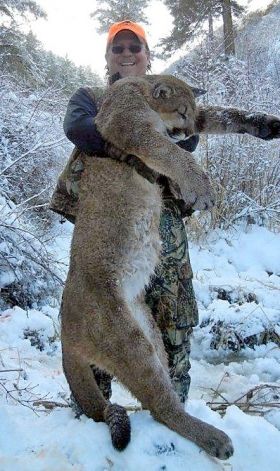
Dan Richards, president of the California Fish and Game Commission, was ousted by a vote of the Commission at the Commission meeting in Fresno on Wednesday. He has been severely criticized in public media over the past few months for legally taking a mountain lion while on a fair chase hunt in Idaho (where mountain lions are legal game).


Dan Richards in Idaho with the mountain lion that eventually got HIM

As usual, the Humane Society of the United States sought to garner whatever benefit they could from this news cycle...

"Californians have twice voted in a resounding fashion to protect mountain lions in our state, and his flagrant flaunting of his disagreement with the electorate put him out of sync with California," said Jennifer Fearing, state director of the Humane Society of the United States. "We're glad to see the commission take action."


Richards, one of the few members of the Commission who is actually a sportsman, was replaced by Jim Kellogg.  Thanks for your unpaid and unappreciated service, Dan.


 File this under "tyranny of the masses".

Saturday, January 21, 2012

California DFG throws West Coast striped bass under the bus...

Photo from California DFG  website

The striped bass has been an important Northern California fishery for over a century. But since the beginning of massive water exports from the Delta in the 1980s the population has been seriously reduced – along with the historic chinook salmon runs and a number of native Delta species.

Just as the Striped bass in California were showing signs of recovery, the California Department of Fish and Game has proposed new regulations that include...
  • Increasing the daily limit from two stripers to six stripers
  • Lower the minimum size limit from 18” to 12”
  • Establish a South Delta catch limit of FORTY fish per day
  • Allow taking in a number of coastal rivers south of SF Bay that have previously been off limits

If this sounds like a plan to decimate the striped bass fishery, it is. Why?

The problem is the Endangered Species Act, Delta water pumping and the greed of powerful southern agriculture interests.

The ESA has mandated protection of certain Delta species... notably the chinook salmon and the delta smelt. This resulted in curtailing water exports from the Delta, which reduced the amount of cheap water being shipped south to irrigate the crops of agribusiness in the San Joaquin Valley.

These agribusiness interests, operating under the benign sounding name of the Coalition for a Sustainable Delta, brought suit in Federal court claiming that the reduction in these now endangered species was not due to the 6,633,000 acre feet of being exported out of the Delta system, but was due to the predations of the striped bass – an introduced species that would not be protected under the ESA in California. The fact that the striped bass and other Delta species existed side by side without problems until massive water exports began and that there is almost no scientific data to link striped bass to reduction in native Delta species did not cloud their thinking in the least.

NOTE: To provide a scale for comparison, the 2011 Delta water exports would flood the entire surface of the Commonwealth of Massachusetts (10,555 square miles) with a foot of water...

In short, the court ordered the DFG to prepare a 'management plan' that would redress this striped bass “problem”. The DFG responded with it's new proposal in November of 2011. Biology had nuthin' to do with it...
Here are some facts about fish endangered by the Delta pumps feeding the California and Central Valley Water Projects...

The annual export total, including water diverted by the Contra Costa Canal and North Bay Aqueduct, was 6,633,000 acre-feet in 2011 – 163,000 acre-feet more than the previous record of 6,470,000 acre-feet set in 2005, according to DWR data. The annual export total, excluding water diverted by the Contra Costa Canal and North Bay Aqueduct, was 6,520,000 acre-feet in 2011 – 217,000 acre-feet more than the previous record of 6,303,000 acre-feet set in 2005. 

One of the reasons for the record-setting pumping is that much of the water this year went to refill the underground Kern Water Bank, largely controlled by billionaire farmer Stewart Resnick, and to the smaller Diamond Valley reservoir, which serves Southern California,” according to Mike Taugher of the Contra Costa Times. (http://www.mercurynews.com/breaking-news/ci_19014459
Ironically, the Metropolitan Water District of Southern California offered water at discount prices in 2011, since southern California reservoirs largely filled. 
'Southern California’s water wholesaler is offering up cut-rate surplus supplies for the first time since 2007, but few local providers can buy in because they are short on storage space,...' according to an article by Janet Zimmerman in the Riverside Press-Enterprise on July 10. (http://www.pe.com/localnews/stories/PE_News_Local_D_surplus11.3abcf4c.html
The record pumping from the Delta – used to fill the Stewart Resnick-controlled Kern Water Bank and southern California reservoirs – resulted in a huge, unprecedented fish kill at the Delta pumps in 2011. Agency staff “salvaged” a total of 11,158,025 fish in the Delta water pumping facilities between January 1 and September 7, 2011 alone. 
A horrific 8,985,009 Sacramento splittail, the largest number ever recorded, were salvaged during this period, according to DFG data. The previous record salvage number for the splittail, a native minnow found only in the Sacramento-San Joaquin River system, was 5.5 million in 2006. 
The fish “salvaged” at the “death pumps” of the state and federal water projects also include hundreds of thousands of threadfin shad, striped bass, American shad, white catfish and other species. DFG data reveals that 742,850 threadfin shad, 514,921 American shad, 496,601 striped bass and 100,373 white catfish were “salvaged” between January 1 and September 7 of this year. 
Agency staff also “salvaged” 35,560 Sacramento River spring run and fall run chinooks, 1,642 Central Valley steelhead and 14 green sturgeon in the project facilities during the same period. 
While no comprehensive studies have been conducted on how many of the salvaged fish survive, fish advocates believe that the majority of many species perish during and after the salvage process. 
Although the salvage counts are certainly alarming, the overall loss of fish in and around the State Water Project and Central Valley Project facilities is believed to be much greater than the salvage counts. The actual loss could be 5 to 10 times the salvage numbers, according to “A Review of Delta Fish Population Losses from Pumping Operations in the Sacramento-San Joaquin River Delta,” prepared by Larry Walker Associates in January 2010 for the Sacramento Regional County Sanitation District – Facts researched and assembled by Mr. Dan Blanton

More to come on the latest in sanity of California game management and water policy.
Wednesday, March 18, 2009

SB 250 - Mandatory Spay/Neuter in California is back!

AB 1634 - the mandatory spay and neuter bill introduced by Senator Lloyd Levine and defeated after a prolonged struggle over the last two years is back - this time as SB 250 - introduced by Senator Dean Florez (Democrat., Fresno/Bakersfield). Kern County, the core of Flores' constituency, has the worst shelter kill record in the state. They kill a lot of adoptable dogs in Kern County. 

The name has been changed, but it's the same old crap. In a state that is struggling with huge revenue shortfalls and divisive politics do we need to pursue these costly, frivolous and punitive attacks against the property of the taxpayers? While school districts are laying off teachers are we going to be hiring more dog catchers? Apparently so.

Senator Florez' website provides a bio that includes this description of his areas of activity...

Florez has been an outspoken leader in the areas of clean air, equality in education, food safety, animal rights, high-speed rail, government accountability and infrastructure financing and development.

I guess that "Animal Rights" includes mandatory animal mutilation. Right? 

He bills himself as a finance professional and is a Harvard MBA graduate. He is Majority leader in the Senate. Perhaps he chooses to ignore the burdensome costs that this proposed law will place on municipalities (already over-stressed), enforcement professionals and the dog owning taxpayers of California - who are already seething over the mismanagement and new taxes being levied on them in Sacramento by a predominantly Democratic legislature. Do I smell revolt in the air? I sure as Hell hope so!

Here is a link to the text. Please read it, get mad, and fire off a letter to your California State Senator in opposition. Then go on strike. The idiots in Sacramento are living in a dream world, and this is another piece of compelling evidence.

Tuesday, January 6, 2009

As close to politics as I want to get on this blog...

In an article reviewing the role that VP Dick Cheney played in the Bush Administration's environmental policy and decisions, I found a vindication of what I long ago came to believe was a purely White House driven political act - the de-watering of the Klamath River to levels that provoked the death of an estimated 100,000 salmon.

This makes me 'right', but it does not not make me feel any better. Perhaps we should all feel worse that it is possible for a single man to countermand legal safeguards put in place by the legislature at the recommendation of unbiased scientists. 

And the valuable crops that had to be saved for the Klamath basin farmers? Mint. That's right, the stuff used to make mint juleps, chocolate mint ice cream, tooth paste, and chewing gum.

Friday, December 26, 2008

The Good, the Bad and the Ugly

I have been reading and watching the development of a phenomena. The term 'Purebred' applied to dogs is being transformed from a positive into a pejorative.

Since the airing of the BBC's exposé of pedigree dogs, an attack on the breeding of show dogs in the UK, the term purebred has begun to represent all that is bad in dog breeding and keeping. The BBC report showed that these bench bred dogs were being bred with high incidences of genetic diseases. It was illustrated with grisly and disturbing videos showing some very nasty stuff.

My dictionary tells me that purebred (when applied to an animal) means, “bred from parents of the same breed or variety.” Pretty innocent usage. But there is a potential threat when concerned people – knowledgeable and otherwise – suggest that something needs to be fixed and politics and regulation raise their ugly head. Animal welfare and animal rights organizations have joined in with condemnation and contempt for people who bred pedigree (purebred) dogs.

I would like to use this forum to try to sort the rat shit from the pepper.

What is a pedigree?

Simple – a record of an animal's ancestry showing it to be purebred. Without debunking this idea here, I'll simply say that in and of itself, a pedigree is meaningless – simply a tool for a breeder's use in tracking a dog's ancestry.

To get closer to the root of the controversy it is necessary to examine the breed clubs, registries, breeding pools, and, especially, the breeders of dogs, their practices and motives.

Breeding and breed standards

The AKC is a for profit registry for dogs. They codify breed standards that are developed by the member breed clubs. They maintain the registries for recognized breeds, and sanction shows and to a lesser extent, field and performance trials.

The standard for English setters, for example, states:

An elegant, substantial and symmetrical gun dog suggesting the ideal blend of strength, stamina, grace, and style. Flat-coated with feathering of good length. Gaiting freely and smoothly with long forward reach, strong rear drive and firm topline. Males decidedly masculine without coarseness. Females decidedly feminine without over-refinement. Overall appearance, balance, gait, and purpose to be given more emphasis than any component part. Above all, extremes of anything distort type and must be faulted.

It goes on to describe the desired physical attributes of an 'ideal' English setter. The standard was most recently ratified in 1988, after the breed had been in existence for at least 300 years. This suggests that the Breed Standard is subject to whim and revision.

What is missing? Any mention of function or capability – nose, endurance, intelligence, pointing and hunting instinct – the very things that motivated the development of the breed and allow it to do its job are nowhere mentioned in the AKC breed standard. A pity that the English setter's very reason for being has been so lightly discarded.

In this breed the bench (show) lines diverged from the field (hunting) lines long ago, and the gulf between them grows ever wider.

It has been seriously suggested that breed registries should be eliminated – that breed standards should not exist. Two different things, in my view.

If the goal is to breed healthy dogs, a registry is a critical tool in understanding and breeding sound dogs. It is the breed standards that need to be changed. The reliance on a physical description needs to be tempered, at least, with a minimum performance standard. The likelyhood of this happening is very low, indeed.

The Field Dog Stud Book is a registry of pointing breeds (open to any pointing breed) that has no breed clubs and no breed standards. This has been working well for the FDSB breeders for over 100 years, because these breeders are interested in a single goal – performance in the field. And field trials are the place where this performance is proved. That is their standard.

Open and closed book

Most registries are 'closed' – that is, they do not accept dogs of other breeds or unregistered dogs as breeding candidates. This is not harmful if the gene pool within a breed is large and diverse and breeders are working to breed sound dogs. If the breeding population is small and/or carries a heavy burden of negative genetic traits, it is not healthy.

Some people are calling for open registries with the idea that this would be good for an at risk breed. Perhaps it would... the red setter breeders interested in reviving the field capability of their breed proposed breeding to the higher performing lines of English setters were met with a hailstorm of protest from the AKC breed club, and ended up going their own way and registering with the FDSB. But if I breed my English setter to an Airdale, what do I get? Not an English setter, but a largely unknown mix of genetics. I cannot see how this helps me get a better setter or a better Airdale. Of course, the bird dog world is rife with suspicion that so-and-so breed pointers into his German shorthair or setter line. And it happens.

Fix the problem, not the blame

My take on this is that dog breeding is subject to Mendelian genetics. Breed junk and that is what you will get. Breeding run of the breed dogs will only result in producing the mean of genetics common to all dogs in the breeding population, and the overall quality of dogs will tend to decline over time. But breeding within a line of dogs and outcrossing for strong contributions from outstanding individuals in the breed, and culling (removing from the pool of breeding candidates) for sound dogs with desired performance characteristics will result in dogs that have less genetic faults than the general breed population and that will perform better. Over time, this breeding ethic, an overhaul or elimination of breed standards, and a strict registry will raise the overall level of the breed.

Political fallout

I sincerely hope that there are no attempts to further 'regulate' dog breeding. This only plays into the agenda of organizations who would like to eliminate the private ownership of animals by making dogs more difficult to breed, obtain, and keep. And believe me, these organizations are working at all levels of government to make this threat a reality.