Showing posts with label Game birds. Show all posts

Tuesday, December 20, 2022

Saturday, December 26, 2020

Indian Head Whiski - Jim


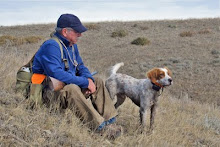
Jim is turning out to be quite a bird dog. I've had him out several times this season hunting both chukar and pheasant. Chukar seem to be a bit easier on him than these cagey old roosters. The chukar have been holding a little better, and even if they do run a little in front of the dog, you can usually put them up. When a dog points chukar you generally get some form of bird-work; even if it's chasing them across a hillside and having them flush wild on you. Roosters just seem to disappear; vanish. It's aggravating. Prior to pointing this old bird Jim had several very staunch points which had me running to the front of him and flushing like a mad man; to no avail. He was pointing with such intensity I thought a bird was there; hen or rooster I just wanted to flush him a bird. After trying to kick a bird out for a minute or so, I'd release him, and off we'd go hunting again. When this rooster hit the ground I cut Jim loose so he could get his mouth on the bird; he pounced on it, he mouthed and pawed at it, he snarfed it and got a general nose-full. Based on his reaction after reaching the bird, it seemed to be just what he needed......

Monday, November 9, 2020

My Opener


 I generally consider November 1 the start of my upland hunting season. I'm not a fan of opening day crowds, mosquitos, pin feathers, or the heat, or snakes.... I like to run two or three dogs a day, one at a time; and in the early season, when it's hot, it's tough to do that. By November things have started to cool off, the crowds have thinned a little, and hopefully my dogs are tuned-up and ready to hunt. This past weekend there was a skiff of snow on the ground, a cool north wind, and things felt just right with a couple layers of wool up top, heavy pants and socks down below, nice gloves; perfect conditions......

Tuesday, February 26, 2019

Crown Jewel

Chukar Partridge - Red-legged Devil

Thursday, January 17, 2019

News From Chukar Country

Wheels with a chukar --- photo by Holly Higgins
The first half of the season was dry and coming across fresh sign of a covey was generally reserved for a location near water or, on the north and north-east slopes of chukar country. It seems as though some weather and a little green-up have had a positive affect on the birds activity and they are a little more dispersed now than they were earlier. Quite a few hunts early in the season left both hunter and dog with only a humbled heart and sore legs and pads. Finally the dogs have been rewarded for their amazing efforts, and some feathers have been added to the vest.....

Monday, April 16, 2018

Sage Grouse

Photo by Holly Higgins
Sage Grouse are congregating on their ancestral strutting/breeding grounds called "leks" throughout the Great Basin right now. The cocks have been on the leks since late winter awaiting the arrival of the hens. Now that the hens are arriving, the courtship ritual of strutting, fanning of tail-feathers, wing movements, and the inflating and deflating of brightly colored air sacs by the cocks will ensue. From this strutting display the females will then choose the most attractive male to breed with.The grouse pictured above were spotted on a lek in eastern Oregon.

Monday, January 22, 2018

The Reward


More often than not, about the only thing I come off the mountain with after a day spent chukar hunting is a pair of sore legs. When I do get a couple birds I usually pick them clean of feathers, and in the process, try to leave as much of the skin on them as I can; which is tough because it's so easily torn and separates from the body readily. Lately I've been brining my birds after I dress them out. I have found the skin seems to hold that salty brine in it, adding a lot of flavor to the bird. The brine also draws residual blood out of the body parts and adds some juiciness and flavor to the meat; just don't over cook it. Here I butterflied a brined bird, spiced it up with a little Kosher salt and coarse-ground pepper, and grilled it. On the side are a couple carrot halves and a slaw I dressed with a honey-dijon vinaigrette. The wine was a California Syrah.

Thursday, March 10, 2011

Say goodbye to Mearn's quail?


I am posting this contribution from Roy Pool of Arizona to make everyone aware of the fragile nature of our Mearn's quail populations. As always, game species management has a lot of stakeholders - hunters, land owners, grazers, and local, state and federal government agencies. Food for thought and a warning.

For years, those of us who live in or near Mearn's quail country have been frustrated with the Arizona Game and Fish Department's lack of response to the ebbs and flows of Mearn's quail populations. The feeling of most long time Mearn's quail hunters is that AzG&F does nothing to manage the resource - and that is the best that can be said of the Department concerning Mearn's quail. The worst that is said, and said often, is that AzG&F is ruled by marketers that promote Mearn's quail hunting to such an extent that the resource is threatened with extirpation in the best areas. The Department, its detractors say, ignores the advice of biologists that base their recommendations on solid in-the-field science, focusing instead on an effort to attract non-resident hunter dollars to the state.

In December 2009, I realized that Mearn's quail were in trouble. There was a monsoon failure that year and Mearn's quail reproduction was near zero in most of the best places that Mearn's quail are found in the USA. If you knew where to go and had good dogs, you could still find 6 or 7 coveys in a day's hunting but all the coveys - I hesitate to call them that - were pairs or 3-4 birds, all adults. Although the failure of the summer rains meant very low grass production in most areas, there was no reduction in grazing allotments in the National Forests where most Mearn's quail are found. Consequently, most of us expected a lower than usual over-winter survival of Mearn's quail and we braced ourselves for another poor season this year.

In June or July of 2010 - I'll have to look up the date - I reported a shocking dearth of quail found when I took a friend to the two best canyons there are in Mearn's quail country - and believe me, I know every canyon there is down here. I told him that I expected to find far fewer quail than in average years, but we'd find some, at least 10 pairs, with the help of my very experienced dogs. We found none at all, zero, no tracks, no scratchings, no sign at all. Something was terribly wrong in Mearn's quail country.

Well, with the help of another Mearn's hunter I found out what was wrong. He sent me an abstract from a wildlife biologist's Ph.D. dissertation. This biologist's research study is Mearn's quail ecology and his study area is in the heart of Mearn's quail country here in Arizona. What went wrong in Mearn's quail country last year was this: we had a week of unprecedented cold temperatures, in the teens, and most of the quail literally froze to death on their roosts. Mearn's quail are a subtropical species and their USA populations occupy the northern-most fringe of their range. Here, in Arizona, they are found mostly at high elevations, above 4,000 ft, and brother, it got cold there last year. That, coupled with the small covey size - Mearn's quail roost on the ground like bobwhites and there were too few birds in most coveys to keep them warm - killed the birds. Many, perhaps most, areas experienced a 90% or greater mortality. Many of the best areas that I visited personally with my best dogs had a complete wipe out - there were no quail at all.

There was a lot of pressure on the AzG&F Department to act to protect the resource. That is their primary responsibility, after all. AzG&F's response was, well, no response at all. The Mearn's quail season was just as long as it's always been and the bag limits were unchanged. When asked why the Department failed to protect what was left of the Mearn's quail resource, AzG&F spokespersons gave these excuses:

(1). No one knew that the quail were in trouble prior to the opening week of the season. Well, my response to this excuse is - what a crock of bs! The biologist who documented the drastic die-off of quail sent his findings to AzG&F in writing, recommending a complete closure of the hunting season months before the season took place.

(2). The season and bag limits were already printed in the hunting regulation booklet and it was too late to change anything. My response - why is it impossible for AzG&F to act at any time at all to protect the resource? Other states do it, why not Arizona? 

(3). "Oh," one guy at AzG&F told me, "the birds will come back. Populations boom and bust all the time. The birds always come back." Hmmm, where have I heard that line before? …How about those of you who live in what was historically the greatest, most productive bobwhite range in the country, the southeast - have you heard that line?… Those places were quail heaven when I was doing my master's research on quail ecology, way back in the 70's. How's the quail hunting there now, folks?

(4). "Hunting is self limiting," I was told. "Hunters that go out on 
Opening Day and don't find any quail don't come back, so we don't need to close the season."  Well, I used to think that is true and it probably is in most places but it is not true in Mearn's quail country and here's why it isn't true. Have you ever heard the old saying that 10% of the fishermen catch 90% of the fish? Well, that is also the case when it comes to the Mearn's quail hunter harvest. There is a special set of circumstances that will make it always true, here in Mearn's quail country. The 10% of the hunters that get all the quail are mostly old, retired guys like me, guys that winter here and hunt every day. …One fellow I talked to explained why. "I'm 73 years old, Roy," he told me. "My dog is 8. I can hunt now and my dog can too, but the clock is ticking for both of us. How long will it take for the quail to come back? Five years, 10?"  I can't blame him, really, but if AzG&F closed the season, the few quail that are left would be protected from guys like him.

(5). "The hunter harvest is compensatory mortality, not additive," I heard for the umpteenth time. "Birds killed by hunters would have died from natural causes anyway, all the quail studies have shown that." Well, not all the studies have shown that and I can provide documentary evidence collected by scientists in the field to prove that under some circumstances, hunter kill can be additive. Not only that, but "all the studies" referred to by AzG&F are bobwhite studies, not Mearn's quail studies. 

Here's the thing. When Mearn's quail numbers are so low that only two pairs occupy a canyon that used to support 100, it is vitally important that both those hens survive if there is to be any hope of even one covey in the canyon next year. Even if both hens do survive and the males also, chances are, one of the nests will be lost next summer - there are lots of nest predators in this country. There will be no recovery if there are no birds left to breed. 

As far as I'm concerned AzG&F has been grossly incompetent in performing their function with regard to protecting the Mearn's quail resource. I am the client, you are, too, all of us as hunters. AzG&F has been frustratingly unresponsive to us, the clients who pay their salaries with our hunting license fees. It should be relatively easy to find out where the incompetence lies. If it is the field biologists that fail to gather evidence necessary to let the decision makers act to protect the resource, they should be fired. If the biologists are acting responsibly and competently but the decision makers are failing to act, then they should be fired. 

Sunday, January 30, 2011

The Hungarian Partridge


The 'Hun', known as grey partridge in most of the world, is an introduced species common in the Northern tier of the United Sates from Washington to Wisconsin. It has also established strong populations in the prairie provinces of Alberta, Saskatchewan and Manitoba. In Europe, the grey partridge is distributed from Southern Portugal, Italy and Greece to the United Kingdom, Finland, and Northern Russia. It is a popular game bird across it's broad range.

The Hun is one of the finest species in North America for availability, sporting qualities and dog work. This position has traditionally been held by the bobwhite quail, which has declined rapidly across almost all its original range over the past twenty to thirty years.

The first Huns I ever saw flushed through the snow from under my horse's feet while I was riding through the breaks of the Snake River one November, many years ago. I was taken by them immediately. Since then I have hunted them in Nevada, Oregon, Washington, Idaho, Montana, North Dakota and Saskatchewan. I am hooked on Hunsand the beautiful country they inhabit.

The photo above was taken one of our Montana hunts by Clair Kofoed, was published in Shooting Sportsman Magazine, and I swiped a copy to post here. Clair has an eye for a great photo and this one is one of my favorites. 

Thursday, December 2, 2010

Walkin' around camera

After I drowned my Cannon digital in the Wenaha RIver, I started to consider the virtues of a 'waterproof' digital pocket camera. After a very brief review of the options available, I bought an Olympus Stylus Tough-8010. The picture quality is not likely to be quite what the Canon offered, but the small size and ruggedness will be much appreciated on my walks.
This was shot yesterday - the Fox C grade with two valley quail taken on BLM ground on the Eastern side of the Sacramento River. 


Wednesday, June 16, 2010

Hazel Grouse and Charlie


From Charlie Hjerpe... Bonasa bonasia (the hazel grouse or hjerpe) is the hjerpe bird of Sweden, from which my last name derives. It has, however, a wide distribution in northern Europe and Asia, its range extending east across Russia, Siberia, Mongolia, China and on to North and South Korea, Sakhalin Island and the north island of Japan (Hokkaido). In Europe it is also found in Norway, Finland, eastern France, Belgium, Luxembourg, Germany,  Hungary, Poland, Czech Republic, Slovakia, Austria, Estonia, Latvia, Lithuania, Belarus, Bulgaria, Romania, Switzerland, Italy, Albania, and Ukraine. It is closely related to the ruffed grouse of North America (same genus), the bird that I hunted almost exclusively, as a boy growing up in Connecticut.
 -- Charlie

Friday, March 5, 2010

USFWS decides not to add Sage Grouse to ESA list... yet

In a release by the USFWS, it was announced that, while the greater sage grouse warrants ESA protection, it will NOT list the game bird under the Endangered Species Act at this time, but will continue to monitor progress (as a candidate species) on an annual basis.

 From the Press Release issued today...

"The determination by the U.S. Fish and Wildlife Service (FWS) today that listing the greater sage-grouse under the Endangered Species Act (ESA) is warranted, but precluded for now, confirms that some of America's most treasured landscapes and game species are in trouble. It is a wake-up call for landowners, industry, and conservationists to work together to reverse the decline of the bird and the land it inhabits. Greater sage-grouse currently occur in only 11 western states: California, Colorado, Idaho, Montana, Nevada, North Dakota, Oregon, South Dakota, Utah, Washington and Wyoming 

"An endangered species listing is no one's first choice as a tool to fix broken landscapes," said Ted Toombs, Rocky Mountain Regional Director of the Center for Conservation Incentives at Environmental Defense Fund (EDF) and a member of several state technical committees for the Natural Resources Conservation Service (NRCS). "It is really a last resort option to keep species from going extinct."

"The first, best option to protect species is for conservationists, farmers, ranchers, energy companies, the recreation industry, and other stakeholders to work together on habitat conservation and restoration, so that an endangered species listing can be avoided," Toombs added. "Many western industries -- including tourism, hunting and livestock -- depend on the same thing as this iconic bird: healthy, productive, open lands."

According to FWS, while the bird's decline warrants listing, it must be delayed due to the backlog of other species that are already candidates for ESA listing. Whazzat again? This statement seems to imply that the USFWS is unable to fulfill their mandate to protect our fish and wildlife resources.

The press release goes on to quote representatives of the oil and gas, windfarm and ranching industries promising that they will improve their operations to have less impact on sage grouse habitat. Further, any landowner who engages in a Candidate Conservation Agreement with Assurances (CCAA). CCAAs protect landowners who voluntarily adopt habitat restoration measures from future land use regulations in the case that this game bird is granted endangered status, with the goal of avoiding endangered species listing. However, if the species is listed in the future, the landowner is absolved of any obligations beyond the CCAA. Last month, FWS negotiated the first CCAA to protect the greater sage-grouse in the nation with landowners in southwest Idaho and the Idaho Department of Fish and Game. FWS is negotiating similar pacts elsewhere in Idaho, Wyoming and other western states inhabited by ESA candidate species. I am uncertain, given zero history on this program (in regards to sage grouse) whether this is a silver bullet or a trap door. 

I guess we will have to wait and see if politics, public lands resource management, and voluntary programs by rancher and extractive users will save the greater sage grouse. Hasn't happened yet.

Tuesday, March 2, 2010

Oil & gas development in the Intermountain West

In a peer reviewed study by PLoS ONE published last October, it was estimated that about 8.4 million acres of sage brush habitat and 2.7 million acres of grasslands in the Intermountain West will be impacted by oil and gas development. I imagine that at least some of the areas shown here are familiar to many of you.
The map above shows the potential for oil and gas development from low to high. Areas in red have the highest potential and tan have the lowest. Black dots (the black clusters) show producing (active or inactive) well locations (IHS, Inc.). Click on the map for a larger view. Map from PLoS ONE.

Greater Sage Grouse dilemma


Once there were more than 2 million sage grouse throughout the West. Now, the best estimate is that there are somewhere between 200,000 and 300,000 of the birds left in the United States, mostly in Wyoming, Colorado, Montana and Idaho. For those of us who run bird dogs in these areas, the decline is evident. Populations have been declining for years.

Accordingly, the US Fish and Wildlife Service is considering the greater sage grouse for endangered status under the Endangered Species Act (ESA). The USFWS says that they will send their decision to the Federal Register on March 5th, 2010. No other comment from the people I spoke with in the Wyoming USFWS office. It is worth noting, however, that the USFWS declined to list the Gunnison subspecies in 2006. 

The greater sage grouse was reviewed for ESA listing previously (2004) but the panel responsible, after reviewing the presented scientific evidence chose not to list the bird. In 2007 however, a federal district court concluded that the Fish and Wildlife Service’s (FWS) finding that the listing of the greater sage grouse as “not warranted” was arbitrary and capricious. The court reasoned that FWS ignored the best available science, excluded experts from the listing decision, and failed to logically evaluate the current circumstance of the sage grouse. Furthermore, the court found that FWS invalidated the listing decision partially due to the “inexcusable conduct” of political appointee Julie MacDonald, who tainted the process by editing scientific conclusions.[citation here].

According to the USFWS, “Once listed, a species is afforded the full range of protection available under the ESA including prohibitions on killing, harming or otherwise taking a species. In some instances, species listing can be avoided by development of a Candidate Conservation Agreement that may work to remove potential threats facing the candidate species.”

In states like Wyoming oil and gas production, wind farm energy production, coal mining, and possibly ranching could be heavily impacted. Western states would likely lose valuable jobs and significant tax revenue if the sage grouse is protected throughout its range. An endangered listing would be "absolutely devastating" by requiring sage grouse to be considered ahead of virtually any development in most of the state, said Ryan Lance, deputy chief of staff to Wyoming Governor Dave Freudenthal.

This photo shows the impact of oil and gas extraction, which has blossomed on lands that were once sage grouse habitat. The fragmentation and activity have effectively destroyed greater sage grouse habitat in large areas of several Western states

On the other hand, sage grouse have been declining steadily over most of their range due to habitat destruction, disruption by development activity, and possibly grazing. Add to this the impact that West Nile Virus has had over the past couple of years, and there are many people concerned that, if nothing is done, the sage grouse will be extirpated across most of its range.

The plight of the sage grouse and, apparently, the threat of listing the bird for ESA protection has galvanized all parties concerned – extractive industries, state governments, environmental groups, and public land managers.

The extractive industries are working to prevent listing by sponsoring studies, programs to assist local management, and, I expect, by lobbying anyone who will listen. Western states are making some effort to field sage grouse 'management programs' which might prevent the USFWS from taking them out of the sage grouse management picture by ESA listing the sage grouse. Environmental groups are fighting to have the native grouse listed, which would severely limit habitat encroachment.

Strangely, there seems to be little active interest among upland bird hunters, even though this would be the first game bird to be listed under the ESA.

There seems to be little common ground here - perhaps it is too late to find common ground. It is too bad that we lack the foresight and citizenship to work to prevent crisis management in which everyone may lose, especially the the very object we are trying to protect... the greater sage grouse.

Tuesday, January 6, 2009

Idaho partridge season closes early

The state of Idaho has closed their chukar and Hungarian partridge season as of Jan 10th. This is to assist in minimizing the take of birds that are vulnerable due to very heavy show across the state.

This is a good thing as the birds will concentrate on the open areas at lower elevations - often near a road. This invites the taking of birds when they are very vulnerable.

Friday, November 28, 2008

Chukar and Fox

I don't like 'tailgate photos' of a row of dead birds and grinning hunters.  Seems like a missed opportunity to record a bagged bird some better way. I shot this photo about a dozen years ago, and like the composition with the frost colored leaves. Nikon F2AS - Fujichrome Velvia

Saturday, November 22, 2008

Blue grouse

After hunting blue grouse as an 'incidental' bird for some years, I am finding them to be challenging quarry in their usual habitat, 

Blue grouse often roost in large trees on the edge of a canyon or swale that allows a launch downhill into escape cover. In northeast Oregon a spot I often visit has a number of large fir trees along the edge of a very steep canyon - growing in a row about 150 yards long. One day years ago I walked the edge of this row of trees and flushed five blue grouse that launched from the trees, dropping like rocks into the bottom of the canyon, and missed all five birds. I swore to learn to learn to connect on these shots and did improve after some specific practice. This translated into better, but not stellar, bags of birds.

Here is a bird that I bagged while Pete and I were hunting last season near the Snake River. The bird flushed from a copse of trees, I shot and thought I had missed shooting through the screen of evergreen branches, But 45 minutes later, and more then 300 yards down the draw he 'escaped' into, Jesse found and pointed him - laying below a tree with his feet in the air. Lesson learned - follow up the birds that I 'miss'.

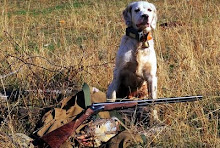
The gun is a Joseph Harkom 16 gauge boxlock that I sometimes carry when an ultra-light gun seems to be called for.

Wednesday, November 19, 2008

Hun's plumage

Thursday, October 30, 2008

Huns


While this year showed sparse populations of chukars, we did find some reasonable coveys - not what we had hoped for, but reasonable.

The good news is that Huns seem to have held up very well, especially in NE Oregon, where we had good dogwork and shooting on numerous, good-sized coveys of Hungarian partridge. They are simply a hardier bird than the chukars. 

The photo above is by Clair Kofoed, and was published in Grays Sporting Journal 2008 bird hunting issue. I sniped it by scanning the page... my 'fee' for being the model. Hope I do not get a 'lawyergram' asking me to remove it, since it is a terrific photo.

Sunday, August 24, 2008

Heath Hen - Interesting website

The heath hen has been extinct since 1932. A website dedicated to the few remaining relics of this bird shows several mounted specimens and compares these birds to the greater prairie chicken. Fascinating.