Showing posts with label Summer. Show all posts

Tuesday, June 23, 2020

Days of Summer

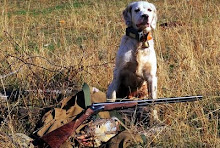
Photo by Holly Higgins
It's that time of year again. Time to get the dogs we hunted and field trialed last season back in to shape, give the broke dogs a tune up and get the puppies that have been pointing and chasing, broke before this fall season. It's a tough time of year to train; the weather is hot, the weeds (foxtail, cheatgrass, madusahead, speargrass) are dangerous, it's snakey, and the hours at work are generally long; time is a scarce resource. The dogs feed is being cut back to help burn off the winter layer of insulation and prepare them for early season field trials and hunts; they will typically be three- to seven-pounds heavier in the winter than in the summer; depending on the dog. Some folks like to change feeds between the high activity level seasons of fall and winter, and the lower activity level seasons of spring and summer. I've always stuck with the same feed year-round, a high quality 30/20 mix, and just regulate the once-daily ration of feed according to the dogs needs. Each dog in the kennel is different in it's daily consumption; some are easy keepers and most aren't. I have a small female that weighs in at about 36-pounds, and may be a couple pounds heavier in the winter, and a male that will go 55-pounds in winter and down to 47-pounds during field trial and bird season. Even at their heaviest, my dogs have a waistline. If hipbones and spine begin to show as they cut weight during the summer, I'll add a little feed to smooth-out the bumps. Pointers and Setters are world class athletes and need to be kept in top physical condition to do their job in the field at the highest level. High quality feed, and access to clean fresh water throughout the day are important in managing your dogs physical condition year-round.

Thursday, June 11, 2020

De La Valdene

Guy De La Valdene is mentioned several times, in Thomas McGuane's "The Longest Silence, A Life In Fishing." Poling Key West with McGuane, angling for bonefish, tarpon, permit (the big three), and mutton snapper among other species. A quick web search put me into a list of De La Valdene's books, and I chose "Making Game...", mostly because I hadn't done much reading on woodcock and the description of the contents of the book sounded interesting. This book covers a few good hunts, but also focuses on habitat, migration, the conservation of the species, and the bird as table fare. I don't know any woodcock hunters, but after reading it, I imagine this book would fit into the niche of "a must have" among the tried-and-true. Russell Chatham illustrated the book, Jim Harrison makes an appearence or two, you get the point..... good stuff!

Thursday, June 4, 2020

McGuane

"The Longest Silence, A Life in Fishing," was composed by Thomas McGuane some twenty-plus years ago. His essays of both salt and freshwater angling span the globe, as McGuane pursues gamefish that most of us only dream to oneday have on the end of our outfit. Anyone that has spent any time on the water will appreciate how McGuane puts you in the moment; whether it be poling the flats of Key West in search of tarpon, permit or bonefish, or presenting a dry to a fat cutty on a gin-clear Montana stream, it's as if you're there with him, wind at your back, hauling line, presenting, and anticipating the strike. I found this book hard to put down. A great book for the spring season, when most of us are looking for a spot to wet a fly, trying to get our birddogs in order, and anticipating the upcoming fall....

Monday, August 10, 2015

Summer doldrums

It has been a tough Summer for a couple of reasons that I don't want to discuss here. But a note of encouragement arrived with a call from John McIltrot, who said that Andy is doing very well - he is becoming a reliable bird finder and a solid bird handler. Photo by John shows Andy (facing the camera) and pointing a bird.


'Little John' Is running all over the prairie and rippin' birds in the best approved puppy style.

I am headed to Montana at the end of the week and will have some fun at John's camp, then head over to Paul Garrett's camp. 


Bird season is comin' and I am starting to feel renewed sense of purpose. 

Monday, July 26, 2010

Summer and heat - again

Dogs – especially sporting dogs - are particularly susceptible to heat stroke. This is a primary danger to our bird dogs. Your dog is far more likely to suffer heatstroke than snakebite, coyote attack, or any other medical problem in the field. It happens rapidly and is often fatal. Because dogs have limited ability to control body temperature (mainly respiration), these mechanisms can fail to control temperatures, and the stage is set for heat stroke. 

Once a dog's body temperature passes above about 105⁰F, changes begin to occur that make it difficult to regain normal temperatures. Oxygen demand increases beyond what can be supplied. As temperature elevates past 108⁰F , cellular damage starts to occur in the kidneys, liver, blood, gastrointestinal tract, heart and brain – how much damage depends on the temperature and duration. Even dogs that do not die immediately may (or will) experience continued problems and die several days later. I know people who have lost dogs they thought would survive, and it is a heartbreaker.

Aggravating factors
Obviously, heat, but it does not have to be extremely hot. Exertion, humidity, lack of hydration, use of some drugs (like antihistamines), and lack of air circulation (as in a closed vehicle or crate) are all associated with canine heat stroke.

Extreme activity will drive body temperatures up very quickly. After high activity, return the dog to an air conditioned space, or wet your dog down stake him out in an area that is shaded and breezy to allow evaporation to further cool the dog. Do not return a wet dog to an enclosed crate – evaporative cooling requires air circulation. Provide plenty of cool fresh water both before and after activity. When hunting and trialing, I find that a dog is usually very receptive to a drink once he has run for 5 or 10 minutes. This is an opportunity to get extra fluids into the dog before he actually needs it. Keep the dogs weight down, provide exercise regularly, and be careful with older dogs.


Evaporative cooling becomes less efficient as the relative humidity rises, so humidity is an important factor as well. Jim Michaletz, a Missouri field trailer, has suggested that combining the air temperature (⁰F) and relative humidity figure is a good index. If, for instance, it is 70⁰F with a relative humidity of 70% to total number would be 140. It could be 85⁰F with a relative humidity of 40% and the total is 125 -- effectively lower.  Jim says that he stops running dogs when the combined number gets above 140.

Signs of heat stroke
Dogs suffering heat stroke will exhibit disorientation, staggering or stumbling, excessive and uncontrolled panting and accelerated heart rate. The gums may appear grayish-pink. They often do not want water or food. When in doubt, assume that the dog has heat stroke and take immediate steps to cool the pup down.

First aid and follow-up
In my opinion, it is far better to over-react than to simply wait and see. Get the dog cool as soon as humanly possible – immersion in cool water will rapidly lower body temperature. Get the dog to a vet immediately for blood tests and IV hydration. If there has been damage the blood test will indicate and additional therapy may be required.

Remember, it's a lot hotter at ground level that on the back of a horse, on an ATV, or even walking. Be careful out there. Better, I think, to err on the side of caution and pick that pup up before he tires and overheats.


EDIT -- I see that there is another useful piece on canine heat stroke on Strideaway by Shawn Wayment, DVM. I highly recommend it! - MS

Saturday, July 10, 2010

Summer Training in Virginia


On July 4th my son and I headed to South Hill, VA to spend some time with professional trainer Pat Casey. Jim Bush, President of the U.S. Complete, was also there.

Jim has a couple of real nice pups on the ground that are being evaluated. It was great fun to watch the youngsters romp through the Virginia countryside.

Riley had three broke finds but let down a little at the flush. She has absolutely zero interest in backing so we've got some work to do before the Fall trial season starts.

My son (13) and middle daughter (16) have shown an increased interest in our dogs and local field trials. They will both start horseback riding lessons next week and I hope to get them enough experience this summer at Pat's place that they can trial the dogs for me while I'm at sea. Few things in life are better than enjoying your favorite hobby with your family.

Wednesday, June 17, 2009

Summer and heat

"Alder Brook" by Chet Reneson

I am always at a loss to determine when Summer officially begins. I went to Wikipedia, and remained unenlightened....

"In some Western countries, especially the USA, (summer is) believed to start at the equinoxes and solstices, based on a misunderstanding of astronomical reckoning. Thus, in the Southern Hemisphere, based on this premise summer begins on the day of the December solstice and ends on the March equinox. When it is summer in the southern hemisphere it is winter in the northern hemisphere, and vice versa. From a purely astronomical viewpoint, the equinoxes and solstices would be the middle of the respective seasons, but a variable seasonal lag means that the meteorological start of the season, which is based on average temperature patterns, occurs several weeks later than the start of the astronomical season. According to meteorologists, summer extends for the whole months of December, January and February in the southern hemisphere, and the whole months of June, July and August in the northern hemisphere..."

My take away on this is that summer begins when it starts to get hotter and is over when it starts to get cooler. So, in spite of cool weather here and in many parts of the West, it is now summer. OK?

In most states training on wild birds may not begin until July 1, in consideration of the Spring nesting period. A good thing, I think. But we can make sure that our dogs get exercise to keep them trim. Since I have setters, I am contemplating a buzz job to keep them cooler as the weather warms up. My wife hates it, but I suspect that it is a help to the dogs, especially when they are running. I am shopping for a quality clipper with the horsepower to make quick work of the coats of four setters. I have used horse clippers in the past, and they worked well. Any suggestions would be appreciated.

Summer means thinking about warm weather hazards to the dogs when out in the field -- heat is a killer, and there are rattlesnakes, foxtails, speargrass and other concerns in many areas. I like to exercise the dogs in the morning before it gets too hot. I have also found fewer rattlesnakes in the morning, compared to the number that seem to become active in the evening, after a hot day.

I always cut back on the amount of food I give the dogs during summer - usually by about 1/3, and I only feed once daily. Some people change the feed to a lower protein/fat food, but I continue with what has proven to work for me - Purina Pro Plan Performance. I just feed less.

Summer means trout fishing and preparing for the fall hunting season. I have been doing much of the later and none of the former. Right now I am getting the bits together to build a dog topper for the truck - I'll post some on this as I make progress. Also beginning to get my Airstream out of mothballs, and do needed work on it. I need to get out and do some fishing before it is too hot. 

The painting above is by Chet Reneson. Chet is a very fine watercolorist, a gentleman, and dedicated outdoorsman. I have a number of paintings and prints by Chet, including a  Bahamian street scene that I gave to to my wife on a recent anniversary. Chet's wife Penny sent us a sheaf of originals to choose from. We picked out one we liked, and sent the rest back. Remarkable in this day and age, I think.