Showing posts with label Animal Rights. Show all posts

Saturday, February 3, 2018

Humane Society CEO resigns after sexual harassment allegations

Reported in the Washington Post on Friday February 2nd...

Wayne Pacelle was apparently sexually harassing staff members, donors and volunteers.

Read more here: https://www.washingtonpost.com/business/economy/humane-society-dismisses-sexual-harassment-complaints-against-ceo-citing-lack-of-credible-evidence/2018/02/02/d5b163c4-083b-11e8-8777-2a059f168dd2_story.html?utm_term=.af94ddcb1d30

Wayne Pacelle, former HSUS  CEO... Were the animals spared?

Friday, December 28, 2012

ASPCA settles racketeering suit - HSUS still on the hook

ASPCA pays $9.3 million in racketeering settlement - what will HSUS do when the hammer drops?

CEO of the Humane Society of the United States, Wayne Pacelle, who paid a key witness for testimony in the fraudulent suit ASPCA and HSUS brought against the owners of Ringling Bros. Circus. Now the tide has turned.


From Humane Watch:

Humane Society of the United States Still Faces Millions in Potential Damages for Alleged Role in Fraudulent RICO Scheme
Washington, D.C.—Today the nonprofit Center for Consumer Freedom calls attention to the breaking news that Feld Entertainment, owner of the Ringling Bros. Circus, has reached a $9.3 million settlement with the American Society for the Prevention of Cruelty to Animals (ASPCA) in connection with a federal lawsuit filed by Feld under the Racketeer Influenced and Corrupt Organization (RICO) Act. Feld’s litigation will continue against other animal rights defendants, including the Humane Society of the United States (HSUS) and two of its attorneys, Jonathan R. Lovvorn and Kimberly D. Ockene, who could be liable for tens of millions of dollars.
Feld’s lawsuit alleges that ASPCA, HSUS, Lovvorn, Ockene, and others took part in an illegal scheme to pursue fraudulent litigation against Feld that dragged through the court for years. Federal judge Emmet G. Sullivan dismissed this previous animal-rights lawsuit in late 2009 after finding that the key witness for the animal-rights plaintiffs was “essentially a paid plaintiff and fact witness who is not credible.” In his dismissal, Sullivan exposed a system by which animal-rights plaintiffs funneled at least $190,000 to this witness. Feld alleges that the Humane Society of the United States sent six payments earmarked to pay this witness through a nonprofit front group controlled by plaintiffs’ counsel. Evidence from court documents shows some of the money was paid to the nonprofit group with an HSUS check signed by CEO Wayne Pacelle.
The massive $9.3 million settlement by the ASPCA indicates that HSUS and other defendants could face tens of millions in damages if they are found to have acted illegally. Feld has stated that it spent $20 million dollars defending against the failed animal-rights litigation, and the RICO Act allows for triple damages.
“While HSUS has spent this holiday season raising money with tear-jerking ads featuring pet rescues, the group really ought to be asking for money to pay for their defense attorneys and shady dealings,” said CCF Executive Director Richard Berman. “This whole racketeering scheme reeks of something out of a mob drama.”
According to public polling, 71 percent of Americans mistakenly believe that HSUS is a pet shelter umbrella group, and 68 percent wrongly think that HSUS spends most of its money on grants to pet shelters. A recent survey of over 1,000 HSUS donors found that the vast majority gave to the group to help pet shelters or reduce pet euthanasia, and upon learning that HSUS gives just one percent of the money it raises to pet shelters, 80 percent of these donors felt HSUS misleads people.
“HSUS cynically scams pet-loving Americans into giving money based on the false impression that HSUS is an organization devoted to sheltering abused dogs and cats, when it doesn’t even run a single pet shelter,” said Berman. “Every dog gets its day—and in HSUS’s case, that day should be in federal court.”

Thursday, November 29, 2012

Sasquatch genome? Come on....

Found this little tidbit on the web...

DALLAS, Nov. 24--A team of scientists can verify that their 5-year long DNA study, currently under peer-review, confirms the existence of a novel hominin hybrid species, commonly called “Bigfoot” or “Sasquatch,” living in North America. Researchers’ extensive DNA sequencing suggests that the legendary Sasquatch is a human relative that arose approximately 15,000 years ago as a hybrid cross of modern Homo sapiens with an unknown primate species.

The study was conducted by a team of experts in genetics, forensics, imaging and pathology, led by Dr. Melba S. Ketchum of Nacogdoches, TX. In response to recent interest in the study, Dr. Ketchum can confirm that her team has sequenced 3 complete Sasquatch nuclear genomes and determined the species is a human hybrid:

“Our study has sequenced 20 whole mitochondrial genomes and utilized next generation sequencing to obtain 3 whole nuclear genomes from purported Sasquatch samples. The genome sequencing shows that Sasquatch mtDNA is identical to modern Homo sapiens, but Sasquatch nuDNA is a novel, unknown hominin related to Homo sapiens and other primate species. Our data indicate that the North American Sasquatch is a hybrid species, the result of males of an unknown hominin species crossing with female Homo sapiens.


I always thought that one determinant of a distinct species was an inability to hydridize with another species...OK, who is concerned enough to have some DNA work done to see if they are a little bit, well, you know?

Read the whole thing and decide for yourself


NEWS FLASH...Man dressed as Bigfoot killed on highway while trying to prompt Sasquatch sighting - You can't make this stuff up... read it HERE

What can I say? It's been raining and I am bored.


Friday, August 10, 2012

Dan Richards ousted by Cal F&G Commission

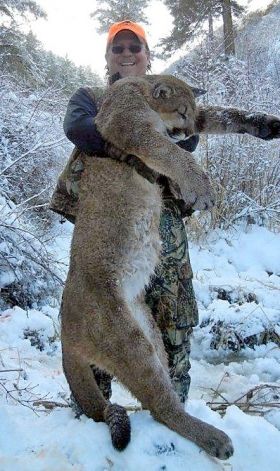
Dan Richards, president of the California Fish and Game Commission, was ousted by a vote of the Commission at the Commission meeting in Fresno on Wednesday. He has been severely criticized in public media over the past few months for legally taking a mountain lion while on a fair chase hunt in Idaho (where mountain lions are legal game).


Dan Richards in Idaho with the mountain lion that eventually got HIM

As usual, the Humane Society of the United States sought to garner whatever benefit they could from this news cycle...

"Californians have twice voted in a resounding fashion to protect mountain lions in our state, and his flagrant flaunting of his disagreement with the electorate put him out of sync with California," said Jennifer Fearing, state director of the Humane Society of the United States. "We're glad to see the commission take action."


Richards, one of the few members of the Commission who is actually a sportsman, was replaced by Jim Kellogg.  Thanks for your unpaid and unappreciated service, Dan.


 File this under "tyranny of the masses".

Thursday, February 25, 2010

Racketeering lawsuit brought against HSUS

Humanewatch reports that the owners of the Ringling Brothers Circus are suing the HSUS and accusing them of racketeering - including laundering money through a shell charity and paying a witness $190,000 in exchange for testimony alleging that the circus abused elephants in their care. The abuse case, brought in New York, was tossed out by the presiding judge, who found that the main witness was not credible. 

I am going to be watching this one...

Saturday, February 20, 2010

New blog watching HSUS. Good, they need watching

A new blog, Humanewatch is keeping tabs on the Humane Society of the United States.  Worth a look to keep track of what the HSUS cretins are doing now. Click the link, and make up your own mind.

Monday, June 15, 2009

California DFG allies with HSUS ?

It seems as though the California Department of Fish and Game has accepted $7,500 from HSUS - the premiere anti-hunting and animal rights group - and announced a 'partnership' with the East Coast-based animal rights organization. Read it Here.

Maybe they are planning on selling bird watching licenses... or maybe they are just selling out. Whaddya think?

Sunday, May 31, 2009

Politics as usual in California

UPDATE - SB 250 passed the California Senate today by ONE vote. Now it goes to the Assembly, where it will be more difficult to defeat. 
______________________________________________

The California State Senate Majority Leader, Dean Florez (D - 16th District) has done an end run in his bid to score points with the Humane Society of the United States. Due to the adverse fiscal impacts of SB 250, a 'one strike' law that requires the spaying or neutering of any dog whose owner is in violation of dog laws (except barking), Florez has shifted the enforcement costs to local municipalities - an end run that lets him claim that it has no impact on the state budget.

The Hayden Act already requires the state to re-imburse local municipalities for the costs of enforcing mandatory state animal control activities. This costs the state $25 million a year. But wait -- the state has already said that they will not be able to pay these claims for at least four years. Now Florez wants to add to that by end running the Local Government Committee and bring SB 250 to the Senate floor without a proper hearing before that committee.

at left, Senator Dean Florez poses with Jennifer Fearing, HSUS lobbyist

Flores has moved to the left on the Animal Rights issues. From his own press release in May of this year... "Jennifer Fearing, a lobbyist for the Humane Society of the United States (HSUS) and one of the chief strategists behind last year's Prop. 2, said this (the realignment of the Senate Ag Committee when Florez assumed the chairmanship) was a big part of the reason for the revamping of the committee. She and her boss, HSUS president Wayne Pacelle, sat down with Florez in December to talk strategy." Damn, I thought I recosgnized the langauge in SB 250 - pure Wayne Pacelle.

Earlier this month - on Wednesday May 19th - Senator Florez appeared with officials of the Humane Society of the United States to debut a new film targeting the food industry. Florez pushed through two other bills - to prevent tail docking of dairy cattle and to force egg farmers to provide larger cages, winning the praise of HSUS chief executive Wayne Pacelle, who said,"It took 100 years to get farm animal legislation moving, but we got two bills within 10 minutes," They must be the best of friends by now.

Hey, DEAN we know you are preparing a run for the Lt. Governorship in 2010, and that a partner like HSUS - with a $120 million annual budget to spend on pushing their animal rights agenda - would be a fine partner for you. My question is... what is it going to cost US, the citizens of California? 

Tuesday, May 19, 2009

ABC Atlanta on HSUS and their money... watch it!


Sorry, you cannot watch this video - it seems that the ABC affiliate in Atlanta has caved in to pressure from HSUS, removed this report from their archive, and demanded that YouTube remove it from their site under threat of copyright litigation. It is a sad day when the free press loses it's nerve. This was a fair and accurate report, and you can find a transcript of it HERE.

Wednesday, February 25, 2009

a petition to consider

For those of you concerned about dog owners' rights and privileges being curtailed by the aggressive lobbying of animal rights organizations like PETA and HSUS who see the recent change in presidential leadership as a golden opportunity, please consider completing this petition put together by PetPAC.

PetPAC is a California-based pet owners advocacy group that is best-known for its efforts in coordinating resistance to a recurring piece of mandatory spay-neuter legislation most recently known as AB1634 -- and happily retired, at least for now.

Tuesday, February 3, 2009

This is it... I promise.

Not wanting to go overboard on the abundant opportunities to poke holes in the sails of the animal rights movement, but browsing Steve Bodio's blog I found an interesting link to the Washington Post website reporting...

"But as with other shifts in our collective tastes in pets, the growing popularity of shelter animals has had an unanticipated side effect -- there is a mismatch between the number of people who want to rescue a dog and the number of dogs needing to be rescued.

In 1970, 24 million dogs and cats were put to death in animal shelters in the United States. By 2007, the number had fallen to 4 million..."

Why? I suggest that the education of people and the availability of low cost, voluntary spay and neuter programs are a big part of the reason, but so is the increase in the number of people who consider adoption when they think of acquiring a dog. Also contributing to this decrease in unwanted pets is the fact that there are far fewer dogs running loose (at least that has been my observation). 

Sunday, January 18, 2009

Who owns the moral high ground here?

I was reading post and comments on Animal Person - a website for self styled animal folks. Much ado about AR 'issues' and Cass Sunstein in particular. Inevitably there is 'agreement' on the broad goals, and discussion with lots of slicing and dicing of words to get around issues of the animal rights agenda that are inconvenient - namely raising and killing animals for food. Of course, they view hunting as a sport death of animals that should be banned entirely.

I fail completely to see why one 'use' of animals (Growing them for food and killing them) is somehow morally superior to other means of killing them for food (hunting). There seems to be no rational basis for the distinction - just the 'feeling' that one is necessary and the other is for sport and therefore repugnant. So the objection to hunting seems to be based solely on the idea that it's OK to kill animals (a necessary evil for the maintenance of society), as long as there is no sport involved. Why? 

Hunting is a far more honorable and connected way to obtain food than reducing an animal to a plastic wrapped, portion controlled 'product' that excuses the squeamish from their own culpability in the death of the creature it was. 

Friday, January 16, 2009

It just keeps getting better

I try very hard to be apolitical, but stupidity and arrogance know no party lines. Reading Steve Bodio's Blog...

Obama's new "regulatory czar", Harvard law prof Cass Sunstein, is getting praise from both liberals and conservatives. But should he?

"In a 2007 speech at Harvard University, Sunstein argued in favor of entirely "eliminating current practices such as … meat eating." He also proposed: "We ought to ban hunting, I suggest, if there isn't a purpose other than sport and fun. That should be against the law. It's time now."... He goes on to recommend that animals be accorded to right to bring suit - represented by a lawyer, of course... and imagine, Cass is a LAWYER. Can you spell altruistic?

Time for lawyers to move from ambulance chasing to chasing cattle trucks, I expect. 

Sunstein's brief reads like a PeTA activist's, and certainly does not reflect the view of 95% of Americans. An appointee to a cabinet level regulatory position should be quizzed by Congress and disclose the full spectrum of his personal views prior to being installed in office. 

Check out the Center for Consumer Freedom article HERE to read, find links and comments.

Friday, December 26, 2008

The Good, the Bad and the Ugly

I have been reading and watching the development of a phenomena. The term 'Purebred' applied to dogs is being transformed from a positive into a pejorative.

Since the airing of the BBC's exposé of pedigree dogs, an attack on the breeding of show dogs in the UK, the term purebred has begun to represent all that is bad in dog breeding and keeping. The BBC report showed that these bench bred dogs were being bred with high incidences of genetic diseases. It was illustrated with grisly and disturbing videos showing some very nasty stuff.

My dictionary tells me that purebred (when applied to an animal) means, “bred from parents of the same breed or variety.” Pretty innocent usage. But there is a potential threat when concerned people – knowledgeable and otherwise – suggest that something needs to be fixed and politics and regulation raise their ugly head. Animal welfare and animal rights organizations have joined in with condemnation and contempt for people who bred pedigree (purebred) dogs.

I would like to use this forum to try to sort the rat shit from the pepper.

What is a pedigree?

Simple – a record of an animal's ancestry showing it to be purebred. Without debunking this idea here, I'll simply say that in and of itself, a pedigree is meaningless – simply a tool for a breeder's use in tracking a dog's ancestry.

To get closer to the root of the controversy it is necessary to examine the breed clubs, registries, breeding pools, and, especially, the breeders of dogs, their practices and motives.

Breeding and breed standards

The AKC is a for profit registry for dogs. They codify breed standards that are developed by the member breed clubs. They maintain the registries for recognized breeds, and sanction shows and to a lesser extent, field and performance trials.

The standard for English setters, for example, states:

An elegant, substantial and symmetrical gun dog suggesting the ideal blend of strength, stamina, grace, and style. Flat-coated with feathering of good length. Gaiting freely and smoothly with long forward reach, strong rear drive and firm topline. Males decidedly masculine without coarseness. Females decidedly feminine without over-refinement. Overall appearance, balance, gait, and purpose to be given more emphasis than any component part. Above all, extremes of anything distort type and must be faulted.

It goes on to describe the desired physical attributes of an 'ideal' English setter. The standard was most recently ratified in 1988, after the breed had been in existence for at least 300 years. This suggests that the Breed Standard is subject to whim and revision.

What is missing? Any mention of function or capability – nose, endurance, intelligence, pointing and hunting instinct – the very things that motivated the development of the breed and allow it to do its job are nowhere mentioned in the AKC breed standard. A pity that the English setter's very reason for being has been so lightly discarded.

In this breed the bench (show) lines diverged from the field (hunting) lines long ago, and the gulf between them grows ever wider.

It has been seriously suggested that breed registries should be eliminated – that breed standards should not exist. Two different things, in my view.

If the goal is to breed healthy dogs, a registry is a critical tool in understanding and breeding sound dogs. It is the breed standards that need to be changed. The reliance on a physical description needs to be tempered, at least, with a minimum performance standard. The likelyhood of this happening is very low, indeed.

The Field Dog Stud Book is a registry of pointing breeds (open to any pointing breed) that has no breed clubs and no breed standards. This has been working well for the FDSB breeders for over 100 years, because these breeders are interested in a single goal – performance in the field. And field trials are the place where this performance is proved. That is their standard.

Open and closed book

Most registries are 'closed' – that is, they do not accept dogs of other breeds or unregistered dogs as breeding candidates. This is not harmful if the gene pool within a breed is large and diverse and breeders are working to breed sound dogs. If the breeding population is small and/or carries a heavy burden of negative genetic traits, it is not healthy.

Some people are calling for open registries with the idea that this would be good for an at risk breed. Perhaps it would... the red setter breeders interested in reviving the field capability of their breed proposed breeding to the higher performing lines of English setters were met with a hailstorm of protest from the AKC breed club, and ended up going their own way and registering with the FDSB. But if I breed my English setter to an Airdale, what do I get? Not an English setter, but a largely unknown mix of genetics. I cannot see how this helps me get a better setter or a better Airdale. Of course, the bird dog world is rife with suspicion that so-and-so breed pointers into his German shorthair or setter line. And it happens.

Fix the problem, not the blame

My take on this is that dog breeding is subject to Mendelian genetics. Breed junk and that is what you will get. Breeding run of the breed dogs will only result in producing the mean of genetics common to all dogs in the breeding population, and the overall quality of dogs will tend to decline over time. But breeding within a line of dogs and outcrossing for strong contributions from outstanding individuals in the breed, and culling (removing from the pool of breeding candidates) for sound dogs with desired performance characteristics will result in dogs that have less genetic faults than the general breed population and that will perform better. Over time, this breeding ethic, an overhaul or elimination of breed standards, and a strict registry will raise the overall level of the breed.

Political fallout

I sincerely hope that there are no attempts to further 'regulate' dog breeding. This only plays into the agenda of organizations who would like to eliminate the private ownership of animals by making dogs more difficult to breed, obtain, and keep. And believe me, these organizations are working at all levels of government to make this threat a reality.

Friday, December 5, 2008

Pocketbook Animal Rights

Pocketbook Animal Rights

The ‘Fart Tax’ and You

by JOHN YATES
American Sporting Dog Alliance
http://www.americansportingdogalliance.org
asda@csonline.net

As if there isn’t enough to worry about, the federal Environmental Protection Agency is telling us that cow farts are hurting the atmosphere and contributing to global warming.

You can stop laughing now.

It’s true. EPA actually is proposing to regulate farmers and ranchers to protect us from emissions from flatulent hogs and cows.

The deadline for comments on the proposed anti-fart regulations passed quietly a week ago.

If the regulations are approved, farmers and ranchers with at least 25 head of livestock will be taxed at $175 per dairy cow, $87.50 per beef cow and $20 per hog.

Preposterous, you might say, and you’re right.

But we would call it something else. We would call it calculated and deliberate.

It stems directly from the animal rights agenda, which is aimed at eliminating animals from American life, including animals that produce meat, milk, eggs and wool. The goal is to reinvent America as a vegan vegetarian society.

We imagine that you are still laughing.

Preposterous! America loves a good t-bone, Big Macs, milkshakes and eggs fried in sausage drippings. Yum.

You are correct in thinking that Americans will not allow meat, eggs and dairy products to be removed from our lives. Surveys show that more than 95-percent of us eat meat and love every bite we can get.

What you may not be thinking is that no one is planning to give us that choice.

The following analysis can be seen as a case study on how the animal rights agenda actually is being implemented in America today. While this example is about the planned elimination of meat, eggs and dairy products from our lives, slight variations in the same strategy also are being used to eliminate companion animals, circuses, rodeos and hunting.

The animal rights groups may be evil personified, but their leaders aren’t dumb. They know that Americans will not give up animal products voluntarily, and they aren’t going to try the direct approach. They’d lose, and they know it.

Their tactic is to indirectly and gradually take away our ability to choose to eat meat.

The logical tactic is to make animal products too expensive for people to use and enjoy regularly, and also to make farming unprofitable and more hassle than it’s worth.
Did you notice how the price of beef skyrocketed after the “mad cow disease” scare a couple of years ago? In about a month, most cuts of beef went up by about two dollars a pound.

The reason is that meat producers were assessed for the cost of a massive federal inspection and regulatory program, and for developing a way to track each animal from the slaughterhouse back in time to the place of its birth.

Suddenly, a half-decent steak costs $10 a pound. If you’re lucky, you can find it on sale for $6.99 or so.

How many people can afford that?

For most people, a juicy t-bone steak probably always has been only an occasional treat, perhaps once or twice a month. Now, it has become once or twice a year.

Have you noticed how small the meat section has become in most grocery stores? Have you noticed how small the portions have become?

I define a good steak as one pound or larger and marbled with fat. Most steaks in the grocery store are a little more than half that size today, and the meat looks like the cow was anorexic.

Part of the reason is the high price of beef. Another part of it is the health scare about cholesterol.

While cholesterol is a valid health concern for many people, the animal rights groups are exploiting this and other health issues to try to make people afraid to eat much meat.

I recall a billboard along I-35 in Dallas that was a photo of former President Ronald Reagan, linking his meat eating preferences with Alzheimer’s disease. Guess who sponsored this crude and tasteless billboard? It wasn’t the American Medical Association. People for the Ethical Treatment of Animals (PETA) paid for the billboard.

If Alzheimer’s doesn’t get you, “mad cow” disease or cholesterol will. That’s the message.

Meat already is being heavily taxed because of the brief “mad cow” disease scare. Now, EPA wants to tax it more because of cow fart emissions.

What’s next? A tax on meat because of its health risks similar to the extra taxes on cigarettes?

Yep. Give ‘em time. It won’t be long before some governmental agency proposes a big tax on every pound of meat to pay for “prevention” programs in the schools and social services agencies, mirrored after the tobacco use prevention campaigns. You’ll know the time has come when you start to see news reports about meat eaters driving up the cost of health insurance.

Enter the $20 a pound t-bone steak.

Exit meat from many people’s budgets.

That’s the plan, but it doesn’t stop here. The next big step is the National Animal Identification System (NAIS), which currently is “voluntary” but is expected to become mandatory soon.

The NAIS plan is to license every location that produces poultry and livestock, and to assign each farm or ranch owner a unique identification number (that also applies to someone who owns a horse, or a couple of 4H goats). Then, at some point, every domestic animal and bird on American farms will be microchipped to determine its place of birth, and it will be tracked on computer all the way from the farm to the grocery store.

Guess how much that is going to cost? Guess who will pay for it?

Microchips can be purchased in bulk today for about $1.50 apiece. Suddenly the $3 frying chicken sold at the grocery store for $1.39 a pound has become a $4.50 chicken.

Add in the cost of bureaucracy and additional expenses for farmers, shippers and slaughterhouses, and it becomes a $6.50 chicken.

A lot of Americans won’t be able to afford to eat much chicken at those prices. It looks like a good time to invest your money in bean burrito company stock.

And that is precisely the plan!

The bureaucratic and compliance costs of NAIA will be enormous. Imagine what it will take to constantly track a truckload of 10,000 chickens individually on computers!

What’s the justification for these costs? “Bird flu,” of course, even though no form of this poultry disease that is communicable to humans has ever been found in the Americas.

The animal rights groups know exactly what they are doing. They find something scary about meat (Alzheimer’s disease, cholesterol, “Mad Cow” disease or “bird flu”) and then work quietly behind the scenes to exploit it. They have a lot of flunky newspaper and TV reporters in their pockets, and a lot of bureaucrats are smelling a lot of job security.

And a frying chicken will cost $6.50…for a small one.

The other side to NAIS is the burden to farmers and the rest of the food industry. Can you imagine the cost to a farmer of microchipping 100,000 chickens a month! How many employees will the farmer have to hire? How many fines will farmers face for microchips that come out? How many people will the trucking companies and slaughterhouses have to employ to scan a few million chickens a day for microchips?

Maybe it will be a $7.50 chicken, if we’re lucky.

“What’s for supper, Honey?”

“Two chicken McNuggets and beans, Sweetheart.”

That’s the plan.

NAIS will be applied first to cattle, hogs and poultry, but also to horses. A person who owns a couple of pleasure horses would have to report to the federal computer anytime they take a ride off of their property. Lord help them if they want to travel with their horses!

Many people believe dogs and cats will be next for NAIS.

Another prong in the animal rights plan is to regulate or eliminate what they allege are cruel “factory farming” practices, such as raising hens for egg production in battery cages. Farmers defend these practices, saying that all of the known needs of chickens are being met, and also that these methods keep the cost of food reasonable so that poor and working class people can afford to have better diets.

But the farmers lost a big battle last month with the overwhelming voter approval of Proposition 2 in California. Following this referendum, almost every egg farm in California will be put out of business.

Only free range chickens, or chickens kept in traditional henhouses, will be permissible. Expect the cost of a dozen eggs to jump to $3 or so. Make it $4 when you factor in NAIS, and $5 when you add the cost of “bird flu” insurance.

Don’t worry. You’ll enjoy bean McMuffins.

Look for a law resembling Proposition 2 to become nationwide within the next few years.

Of course, you can’t have a law without also having cops to enforce it. Every one of these programs will open up every farm in America to unannounced inspections, visits by animal cruelty officers and even vigilante spies from animal rights groups.

How much money will farmers have to spend on attorney fees, paying fines for technical violations (the chicken that lost its microchip), or rebuilding facilities, upgrading computer systems and hiring new employees?

How many farmers will say “enough is enough” and throw in the towel?

How many people will be able to afford to buy milk at $8 a gallon, eggs at $5 a dozen, steaks at $20 a pounds, hamburger at $10 or sausage at $12?

We saw the same thing happen in a different form this year, when HSUS exposed cruelty at a California slaughterhouse. A video showed a downer cow being pushed with a loader.

The firestorm of protest over that incident brought a host of new federal regulations and increased inspections of slaughterhouses, even though the incident was a clear violation of existing laws and regulations. The problem could have been solved easily and simply, but it wasn’t.

Instead, your steak went up another 50-cents a pound.

Dollars and cents is the most effective strategy the animal rights groups have discovered. Who cares if you want to eat meat if you can’t afford it!

Your choices become a moot point.

No matter where you look, activists and social reformers want to use money to limit your choices.

Environmentalists want gasoline to cost $20 a gallon, so you’ll use less of it.

The Humane Society of the United States (HSUS) wants a hamburger to cost $15 at McDonalds, so that you’ll eat your veggie burgers and shut up.

They want gasoline to be expensive, because this will drive up the price of corn used for animal feed and fuel to transport all of America’s foodstuffs, and thus the price of meat for consumers. If gasoline rises to $10 a gallon, you won’t be eating much meat.

HSUS wants to make you pay a few thousand dollars for liability insurance to own a gun, so that you won’t be able to afford to go hunting. Thus, hunting can be eliminated without any politician ever having to cast a vote to do it.

And they also want the price of a puppy to be about $5,000, so that only rich people will be able to afford one and the vast majority of Americans will forget what it is like to love and be loved by a dog.

Wars have been won without ever firing a shot.

And the animal rights war will be won in your pocketbook, if you don’t wise up.

Friday, August 22, 2008

AB 1634 is dying, and shelter programs will likely benefit

The California legislation that would have required mandatory spay or neuter of nearly all dogs and cats in the state is dying in the state legislature due to lack of support. The sponsor, Democrat assemblyman Lloyd Levine (Dem - Van Nuys) has almost zero chance to round up enough votes to get it passed this session - especially given the current (recurrent) budget crisis that is demanding the legislature's closing days. And 'ol Lloyd is termed out and will not be back next session.

Why is this good news for animals, shelters, and animal control officers?

I have been reading a communique from the American Sporting Dog Alliance that, among other things had the following report on the impact of the recent mandatory spay and neuter law in the City of Los Angeles...

The City of Los Angeles passed an ordinance this year that mandates spaying and neutering of virtually all dogs. In theory, the ordinance allows for owners of intact dogs used for show, performance events or breeding to buy expensive special licenses, provided they work through an approved registry. Thus far, no dog registry, including the American Kennel Club, has been approved.

The ordinance is supposed to take effect October 1 but animal control revenues have already plunged, an August 19 audit by City Controller Laura Chick shows.

According to the audit report, license sales and revenues have dropped substantially and the program’s budget is drenched in red ink.

Chick’s fiscal audit found the Los Angeles Animal Services Department has lost “millions of dollars” in revenue by failing to license and renew the licenses of hundreds of thousands of dogs.

A reported 27 animal control officers will have to be laid off, the city doesn’t have the money to open a new $14 million satellite shelter, there has been no money to pay for any of the required community outreach and no money is available to enforce the new ordinance

"If you don't put something behind (the ordinance), then it's a feel-good gesture, and we don't want to be a city that does empty feel-good gestures," City Controller Chick said. "I always think that legislators should research, not only the outcomes and impacts ... but should always research and ask questions about enforcement. Otherwise we, government, run the danger of enacting legislation that is not going to be enforced, which to me is the clearest of messages to our citizenry and our public -- go ahead and be a scofflaw, nothing's going to happen."

Los Angeles also has stalled on a plan to create satellite centers for spay and neuter procedures, as veterinarians simply aren’t signing up to do the job, the audit shows.

It is indeed sad that a shelter program with the potential to save thousands of animals is so thoroughly mismanaged and that politicians stand ready to apply 'feel good' good solutions to problems that are not only based on bad information and unproven methods, but actually obstruct the ability to deal with the problem. 

The HSUS spent a lot of time and money in California to shape, promote and support AB1634 and its local offspring. These have all failed - either to become law, or, in the case of Los Angeles, to demonstrate that mandatory spay and neuter has any viability as a population control measure. And we now have a clear demonstration of how big a disaster municipal animal control operations have been spared statewide. 

Monday, May 19, 2008

Mandatory Spay/Neuter on MSN.com

An article leaning AGAINST mandatory spay and neuter has appeared on MSN.com

The article sites increased health risks and behavioral problems - problems that spay/neuter has traditionally been thought to alleviate - are linked to spaying and neutering of dogs.

Very interesting is the statement from an HSUS spokesperson recommending that spay/neuter is a personal choice - after the many millions they have spent pushing these laws. It is NOT out of character for HSUS to misrepresent their agenda to mainstream media - standard procedure, in fact. They have not changed their radical Animal Rights agenda one iota - just the message when fund raising may be at risk.

Here is the first bit of the article...

As legislators push for more mandatory spay and neuter laws for pets as young as 4 and 6 months in hopes of reducing the number of unwanted animals, critics are crying foul over research showing that such surgeries may raise certain health risks in dogs and therefore shouldn't be required.

Studies have shown that dogs that undergo spaying (removal of the ovaries and uterus) or neutering (removal of the testicles) are at increased risks for certain cancers, thyroid disorder, incontinence and some of the same behavior issues, such as aggression, that the surgeries are said to prevent. 

I strongly recommend that those of you who live in states, counties or municipalities currently that currently have, or or considering, such laws send this information to your lawmakers. They are politicians, mainly, but could possibly understand something written very simply and targeted at a mass audience.

Tuesday, April 22, 2008

Americans oppose mandatory spay and neuter laws

John Yates of the ASDA just sent me a link to a Parade Magazine (that's right! Parade Magazine) current on-line poll asking people to vote on whether they favor or oppose mandatory Spay and Neuter laws that are popping up like toadstools across America. 

The answer? A resounding NO! from over 80% of respondents. Check it out HERE and vote.

Saturday, March 8, 2008

Pet shelter overpopulation - a Boogeyman?

USA Today reports on the importation of thousands of dogs annually to fill the shortages at those 'overcrowded' animal shelters we hear so much about... USA TODAY ARTICLE ... here's an excerpt from the article 

"Pet overpopulation is a misnomer," she [Patti Strand, president of the National Animal Interest Alliance] says. "What we have is a pet distribution problem."

Spay and neutering campaigns
[ed. largely voluntary] have been so successful in much of the USA — especially the Northeast and Northwest — that shelters need to look elsewhere if they want dogs to offer for adoption. But Strand says there is abundance of dogs in other parts of the country such as the South that could make up the difference.

Julie Potter, director of Northeast Animal Shelter, said they take in 800 dogs a year from the South. She said people usually want to adopt younger dogs, so they bring 200 dogs a year from Puerto Rico.

So my question for readers is... do we really have too many animals in shelters, or do the shelters and animal activists simply need to figure out how to get these animals to owners who want them?

Friday, January 11, 2008

PETA - People for the (un)Ethical Treatment of Animals

This from John Yates of ASDA:

WASHINGTON, Jan. 10 - An official report from People for The Ethical Treatment of Animals (PETA), submitted nine months after a Virginia government agency's deadline, shows that the animal rights group put to death more than 97 percent of the dogs, cats, and other pets it took in for adoption in 2006. 

During that year, the well-known animal rights group managed to find adoptive homes for just 12 pets.

The nonprofit Center for Consumer Freedom (CCF) is calling on PETA to either end its hypocritical angel-of-death program, or stop its senseless condemnation of Americans who believe it's perfectly ethical to use animals for food, clothing, and critical medical research. 

Not counting animals PETA held only temporarily in its spay-neuter program, the organization took in 3,061 "companion animals" in 2006, of which it killed 2,981. 

According to Virginia's Department of Agriculture and Consumer Services (VDACS), the average euthanasia rate for humane societies in the state was just 34.7 percent in 2006. 

PETA killed 97.4 percent of the animals it took in. The organization filed its 2006 report this month, nine months after the VDACS deadline of March 31, 2007. 

"Pet lovers should be outraged," said CCF Director of Research David Martosko. "There are thousands of worthwhile animal shelters that deserve Americans' support. PETA is not one of them." 

In courtroom testimony last year, a PETA manager acknowledged that her organization maintains a large walk-in freezer for storing dead animals, and that PETA contracts with a Virginia cremation service to dispose of the bodies. In that trial, two PETA employees were convicted of dumping dead animals in a rural North Carolina trash dumpster. 

Today in Southampton County, Virginia, another PETA employee will face felony charges in a dog-napping case. Andrea Florence Benoit Harris was arrested in late 2006 for allegedly abducting a hunting dog and attempting to transport it to PETA's Norfolk headquarters. 

"PETA raised over $30 million last year," Martosko added, "and it's using that money to kill the only flesh-and-blood animals its employees actually see. The scale of PETA's hypocrisy is simply staggering."