My wife is visiting our daughter this weekend so I cooked up a dinner just for me. I tried a few new things and it all came out quite well.
Start with 2 Oregon chukar and 2 San Diego quail, plucked, with backbones removed. Soak for 2 hours in brine, 1 quart water with 1/2 cup salt, 2 tbs sage and 2 tbs white pepper.
Then, the side dish. Coarsely dice 1 onion and 1 red bell pepper. Cook in olive oil until onions are somewhat brown. Cut the kernels from 2 ears of corn, microwave the kernels for 3 minutes, then add to the onions and peppers. Add 1/2 cup canned drained black beans. Add 1/2 cup Goya "Sofrito" tomato cooking base. Add a bit of water and let it all cook for 5 minutes.
Finally, rinse the birds, tie the legs, season with a lot of ground black pepper, and grill until still pink in the middle. Baste the skin side with butter as the birds finish cooking.
I've never brined whole game birds before and this was simply outstanding. Definitely will do this with most grilled birds in the future. Even the legs were tender and very tasty.
Saturday, November 13, 2010


Game warden murdered
Reported by Carl Bergen...
| David L. Grove, a 31 year old Penna Wildlife Consevation Officer was shot and killed by a convicted felon who did not want to go back to prison. The felon was night hunting and was in possession of a firearm. The suspect was also wounded and in custody with charges of homicide, weapons and game offenses, along with other charges. It has been 95 years since a Pennsylvania Game Warden has been killed in the line of duty. More news here |
Friday, November 12, 2010
One tired puppy

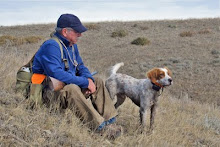
Mike and I joined forces for nearly two weeks in Oregon, then I headed south and spent a final couple of days in the Mojave hunting chukar with my friend Bruce. After a couple weeks of daily work on wild birds my Setter Rosie was handling pretty well; in about 3 hours one morning she gave us nearly a dozen points on a half dozen covies. Exciting stuff. But I could tell it was time to go home from this picture ...
Bruce and I spent that afternoon annoying the ducks in a nearby marsh. The water was generally shallow, the bottom was generally hard, and I the rubber boots I was wearing had been adequate. Then I killed a mallard that fell into a "new" pond. First steps were fine, then I sank to mid-thigh in an invisible soft spot. With Bruce laughing in the background on the shore I lost my balance, fell to my left, and with a gargled "aaaargh" found myself horizontal, right arm clutching my gun above the water. Bruce says that if he had captured the video it would have a million hits on YouTube in the first 24 hours.
Thursday, November 11, 2010
AFTCA Guidelines

Guidelines to Field Trial Procedure and Judicial Practice is a pocket-sized reference book distributed by the Amateur Field Trial Clubs of America (AFTCA). This book contains a wealth of information including descriptions of the All Age and Shooting Dog Standards; what is expected of the Field Trial Marshall and Reporter; minimum qualifications for, and the expectations of, a Judge. And a lot of questions and answers to many issues and situations that a field trialer will run into, from the advertisement of the trial through the running of dogs. The book can be found at http://www.aftca.org/, and is reasonably priced at $3.95 a copy.
Tuesday, November 9, 2010
Works as advertised

Wednesday, October 27, 2010
Early season set-backs
I recently returned from Northeast Oregon. Returned from my hunt early - not something I would usually do.
I ran out of dog. My old dog Jesse is a little long in the tooth and I left him home to keep my wife company. Tommy is in South Carolina in training. So I took Ted and Cody, the six month old puppy. Long story short, we hunted opening weekend but by Monday Ted's foot began to swell and looked really nasty.
To the vet in Enterprise, Oregon (Jereld E. Rice, DVM). Neither of us could find a wound, but it looked a lot like a grass awn in a middle toe. Ted was fevered and the foot was red and swollen to almost twice normal size. The vet prescribed Cephalexin and Rimidyl and said it would probably take 10 days or so to heal, but to come back if I saw changes.
Two days later I let Ted out of his crate to pee, and he decided to go hunting. After Pete and I spent a couple hours looking for him, he showed up at the truck looking contrite, and without his bandage on his foot (I had found most of the bandage downhill and about a mile away earlier in the search). I cleaned his foot and flushed with saline solution and while doing so noticed an entry wound. Back to the vet, where he did some deep cleaning and removed parts of a cheat grass awn. "Give him 10 days", said the vet.
So I hunted with Pete behind his setters, Silk and Rosie and focused on running Cody every day and had a good time watching him learn about chukars and Huns. This was really the bright point of the trip.
But after suffering some back pain in the mornings, shooting poorly when I had opportunities and falling while fishing the Wenaha and ruining my digital camera, I felt I was snake bit and decided to head home to regroup and plan for hunting later in the fall when Ted's foot heals up.
I did enjoy Pete's company, we had some great campfires and ate and drank well. But even I know when to quit.
I ran out of dog. My old dog Jesse is a little long in the tooth and I left him home to keep my wife company. Tommy is in South Carolina in training. So I took Ted and Cody, the six month old puppy. Long story short, we hunted opening weekend but by Monday Ted's foot began to swell and looked really nasty.
To the vet in Enterprise, Oregon (Jereld E. Rice, DVM). Neither of us could find a wound, but it looked a lot like a grass awn in a middle toe. Ted was fevered and the foot was red and swollen to almost twice normal size. The vet prescribed Cephalexin and Rimidyl and said it would probably take 10 days or so to heal, but to come back if I saw changes.
Two days later I let Ted out of his crate to pee, and he decided to go hunting. After Pete and I spent a couple hours looking for him, he showed up at the truck looking contrite, and without his bandage on his foot (I had found most of the bandage downhill and about a mile away earlier in the search). I cleaned his foot and flushed with saline solution and while doing so noticed an entry wound. Back to the vet, where he did some deep cleaning and removed parts of a cheat grass awn. "Give him 10 days", said the vet.
So I hunted with Pete behind his setters, Silk and Rosie and focused on running Cody every day and had a good time watching him learn about chukars and Huns. This was really the bright point of the trip.
But after suffering some back pain in the mornings, shooting poorly when I had opportunities and falling while fishing the Wenaha and ruining my digital camera, I felt I was snake bit and decided to head home to regroup and plan for hunting later in the fall when Ted's foot heals up.
I did enjoy Pete's company, we had some great campfires and ate and drank well. But even I know when to quit.
Selling a 'reject' trial dog
I recently received this contribution from Dr. Charles Hjerpe. Charlie has vast experience raising and training trial dogs, and wrote this as a 'owner's manual' for those people who buy dogs that don't quite cut it as trial prospects.
I should point out that these are not inferior dogs and will often make a real brag dog for the hunter. They simply have some (real or perceived) shortcoming that would hamper their success in field trials.
---------------------------------
To: Yaller’s New Owner
From: Dr. Charles A. Hjerpe
I am going to discuss the positives and negatives of your new bird dog, and make some suggestions on how to work with him to maximize your enjoyment of him and to avoid future problems. This letter is like the Owner’s Manual that you get when you buy a new pickup truck.
A. His Positive Attributes:
Yaller is a well bred, male, English pointer and is registered with the Field Dog Stud Book (FDSB) maintained by the offices of The American Field Publishing Company, 542 South Dearborn Street, Chicago, IL 60605 (312) 663-9797
He is a big, strong, handsome dog that wants to please you.
He has a great nose, and is an excellent bird finder.
He hunts at medium range, and is easy to handle.
He has been yard trained to obey the commands “heel”, “whoa”, and “come here”.
He is trained to move out to the front using short blasts on the whistle, and to turn right or left or to come back to me with the verbal command “How! How! How!” which is repeated until he responds appropriately. If he doesn’t respond, I then change to “Why-you!” “Why-you!” with the accent on the 1st syllable, and “knick” him with the electronic collar until he does. If I want him to come all the way in to me, I begin using the “here” command when he is getting close.
He is steady to wing and shot, and will back another pointing dog on command (the latter means that he may not always back another dog that is on point when he first sees him/her, unless you command him to “whoa”).
He has had a total of 12 weeks of summer horseback training on wild birds in Canada (sharp-tailed grouse), and a total of 8 weeks of winter horseback training on wild birds in Arizona (Gambel’s quail) during 2009 and 2010.
Yaller has one field trial placement, which was a 2nd place in the Mortlach Field Trial Club’s Open Derby Stake. This trial took place on September 14, 2009, in Mortlach, Saskatchewan, Canada. A total of 17 dogs competed in this stake.
B. His Negative Attributes and Deficiencies:
Yaller is afraid of other big male dogs that he doesn’t know, and he doesn’t understand how to behave submissively to avoid conflict. Instead, he will bristle up, growl, make eye contact with, and stare at them. This may cause a dominant alpha male dog to attack him. He will not attack the other dog, and if he is attacked himself, he doesn’t know how to fight and will not fight back. This has never happened while he was actually hunting, only just before or just after hunting. If there will be other hunters and dogs present where you are hunting, I recommend avoiding them while hunting, and taking Yaller out to the field and back to your vehicle while on a leash.
Subscribe to:
Posts (Atom)