Saturday, August 28, 2010

Meet Cody


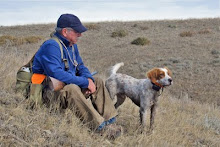
Jerry Lewis poses Cody in North Dakota

On Tuesday of this week, I was in Beach, North Dakota at Jerry Lewis' summer training camp to look at some puppies. We put three pups down and walked them through the fields. One of them was consistently ahead of the others and to the front, handled naturally, and found a covey of sharptails, which he flushed and chased a short distance. Then he rolled back and checked the spot again and put up two more birds. "I like this pup," I thought, "he really hunts!" and after a brief once over to check for any physical problems, Jerry and I made a deal and started the paperwork. 

After leaving Jerry's camp, I headed over to see some dogs at the Montana Shooting Dog Championship in Circle, Montana. Jim Michaletz had a horse for me to ride, and I rode six braces on the spectacular course that the Big Sky Field Trial Club has on the Scott Brown Ranch. I met a number of people I knew only by reputation and phone and e-mail exchanges - Jim Michaletz (owner of my new pup's sire, CH Jetsetter), Tom and Shannon Nygard, Austin Turley, Dave Noel, Jim Tande, Doug Ray, Travis Gelhaus, and others. Everyone made me welcome and I am grateful to all there for an excellent time. After the morning braces, I remained in camp and walked the pup in a little field behind the camp. He found, flash pointed, and flushed a bevy of sharptails and, as he did the day before, went back to the spot and found three stragglers, which he also put up. I was impressed with this determination and good sense in a pup just turned five months old.

So this is Cody (CH Jetsetter X RU-CH Johnny's Jewel - and to be registered as Wenaha Code Red). I have the hope that we all experience with a new puppy - at this point all things are possible.

Thursday, August 19, 2010

Puppy prospects & anticipation


Heading out on Sunday for North Dakota. It's always a crap shoot with a young pup, but I think that raising and developing a young dog is very rewarding and I am anxious to get started.
The pups I will be looking at are a repeat breeding of a nick that produced Terry Erickson's young prospect, Horizon's Jetsetter, pictured above at about 9 months of age. She is a nice, smooth moving pup that seems to have what it takes. Her littermates look as nice and are all very similar.

Wednesday, August 18, 2010

Goodbye and (maybe) hello

Last week I had to put one of my older setters down. A simple bowel obstruction, upon closer examination, led to a sarcoma on the spleen and a unhealthy looking node on a testicle. Rather than put him through a bowel resection, spleen removal and castration with a very dubious prognosis for short term survival, I elected to let him go. This is not easy. Every time I do this it seems that the grief is compounded by the dogs that went before. Benny was a really sweet little maniac. So desperate for birds that I could never trust him completely, and eventually quit hunting him. He was my wife's pet and favorite.

So next week I am making a trek to North Dakota to the summer camp of a well known trainer to evaluate three young puppies. I expect that I will come home with one, if they are like the others I have seen from this breeding. I will have a young dog to develop, and I am excited about the prospect of taking the youngster on my fall bird safari. 

On the way home from North Dakota, I will stop in Circle, Montana to ride braces at the Montana Open Shooting Dog Championship and meet both old friends and some people that I have only known previously through phone conversations and exchanges of e-mail. 

Pictures of puppies, dogs, and field trial to follow.

Thursday, August 12, 2010

Gun X training pistol


The Gun X training pistol is a recent entry into the market that has generated a little discussion in the last few months. I've had the chance to see and use one the last couple of weekends. My impression is that it's very well made and to this point seems quite reliable. It feels much more like an NEF than an ALFA with the overall weight between the two. If I hadn't recently purchased an ALFA, I'd have one of these in a minute.

See http://www.dogsafield.com if you're interested.

Sunday, August 8, 2010

Fishing the Sierra back country

Our extended family & friends spent the past week camping in the Sierras (near the Pickel Meadows Marine Corp training camp for those who know the territory). My cousin and I both purchased float tubes before the trip and made a couple of day hikes to lakes that were a bit off the beaten track. An uninflated float tube fits perfectly within an old external frame Kelty. I'd never tubed before and had a great time floating the lakes, mostly tossing nymphs (thanks Mike).

However, the trout were not cooperative. We both caught plenty of small rainbows on flies in the local rivers but could not even get a strike in the lakes. Finally I gave in to frustration. I switched from my old Pflueger to a spinning reel, attached a mid-size spinner, and began trolling the deep areas of the lake. The results we incredible ...

In the space of an hour I had three strikes and landed two trout, the first 17" and the second 18", each well rounded, probably weighing a bit over two pounds. Prior to this the biggest trout I had caught in the area was 13", and the biggest I had ever heard of was only 15". Wow.

The experience was bittersweet though. I nearly always catch and release in the Sierras but the second trout did not recover. I was using very light tackle (appropriate for the "normal" trout in the area ) and the 5-minute fight exhausted this fine fish. I spent 10 minutes trying to get her swimming again but finally put her on a stringer. Back in camp, we shared the filets for lunch and they were delicious - orange and firm. I also collected 4 or 5 ounces of roe and will try my hand af making caviar.

Hope others are also enjoying these weeks before the bird season kicks off again.

Wednesday, July 28, 2010

Line Breeding, inbreeding and COI

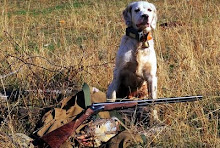
Berg Brothers Head Turner
There has been, off and on, lengthy discussions about 'line breeding', breeding related dogs. The discussion usually revolve around "how close is too close"? One side argues the idea that closely bred dogs are unsound, and that breeding unrelated dogs is a better strategy. Others argue that line breeding, when done properly, results in more consistent litters of above average dogs.  I am one who believes that line breeding has a lot of pluses when done intelligently, and within the framework of a defined program - one that aims at removing dogs that may be carriers of detrimental genetic traits, while taking advantage of positive traits to improve a line of bird dogs.


Scott Berg, of Berg Brothers Setters, has this to say on the subject of line breeding...
"In terms of what is an acceptable level of inbreeding, opinions are going to vary.  There is considerable empirical evidence that supports the position above that COI levels well into the 20s can be sustained.  Personally, I don’t find it necessary to push those limits.  However, the difference between .03 or even .06 and .25 is very wide and the practical implications are very substantial.  The practical implications would be that we would have to focus on diversity not performance to maintain levels at .03 or below.  This approach suggests that breeders have done such a good and consistent job in selection that the consistency we seek in narrowing the gene pool for a specific breeding is already present in the population.  This is a very uninformed position in my opinion.   For starters, 95% of breeders don’t evaluate and cut enough prospects to gain anywhere near this level of consistency.   There are substantial differences in size, build, gait, stamina, heat tolerance, intelligence, biddability, mental make-up, bird finding, manners around game and the traits that make for good companions.

We have always followed a pretty basic premise which is to put a significant number of prospects through a rigid selection process and only retain the superior individuals.  We have experimented with a large percentage of the available ES lines and have evaluated about 250 individuals of my own for breeding purposes.  That number is probably low because we have evaluated 90+ in the past 3 years.   Of course, we also get substantial feedback from clients, and we have trained, trialed with and observed a thousand (literally) other dogs.   Our experience would suggest line breeding produces a significant but not monumental increase consistency and the overall quality of the individuals produced.  We will continue to breed the best individuals and monitor our relative success. 

Line breeding is not very practical for the guy with 4-6 dogs in the backyard.  Actually, I think that is a considerable factor in this method being questioned.  That’s how guys that breed 1-2 litters/year constructs a position that their methods and understanding rival Bob Wehle.  I break par a few times a year but I sure as hell am not going to compare my knowledge of the golf swing to Butch Harmon. 

The relative benefit of line breeding is a constructive topic. I believe that good dogs can be produced in a heterogeneous litter as long as the ancestry consists of exceptional individuals throughout the pedigree.  We have produced many such litters.   However, our observations have been that modest inbreeding (half-sibs or less) produces with greater consistency.  This pattern will produce COIs well below what has PROVEN  to be tolerable levels."

Monday, July 26, 2010

Summer and heat - again

Dogs – especially sporting dogs - are particularly susceptible to heat stroke. This is a primary danger to our bird dogs. Your dog is far more likely to suffer heatstroke than snakebite, coyote attack, or any other medical problem in the field. It happens rapidly and is often fatal. Because dogs have limited ability to control body temperature (mainly respiration), these mechanisms can fail to control temperatures, and the stage is set for heat stroke. 

Once a dog's body temperature passes above about 105⁰F, changes begin to occur that make it difficult to regain normal temperatures. Oxygen demand increases beyond what can be supplied. As temperature elevates past 108⁰F , cellular damage starts to occur in the kidneys, liver, blood, gastrointestinal tract, heart and brain – how much damage depends on the temperature and duration. Even dogs that do not die immediately may (or will) experience continued problems and die several days later. I know people who have lost dogs they thought would survive, and it is a heartbreaker.

Aggravating factors
Obviously, heat, but it does not have to be extremely hot. Exertion, humidity, lack of hydration, use of some drugs (like antihistamines), and lack of air circulation (as in a closed vehicle or crate) are all associated with canine heat stroke.

Extreme activity will drive body temperatures up very quickly. After high activity, return the dog to an air conditioned space, or wet your dog down stake him out in an area that is shaded and breezy to allow evaporation to further cool the dog. Do not return a wet dog to an enclosed crate – evaporative cooling requires air circulation. Provide plenty of cool fresh water both before and after activity. When hunting and trialing, I find that a dog is usually very receptive to a drink once he has run for 5 or 10 minutes. This is an opportunity to get extra fluids into the dog before he actually needs it. Keep the dogs weight down, provide exercise regularly, and be careful with older dogs.


Evaporative cooling becomes less efficient as the relative humidity rises, so humidity is an important factor as well. Jim Michaletz, a Missouri field trailer, has suggested that combining the air temperature (⁰F) and relative humidity figure is a good index. If, for instance, it is 70⁰F with a relative humidity of 70% to total number would be 140. It could be 85⁰F with a relative humidity of 40% and the total is 125 -- effectively lower.  Jim says that he stops running dogs when the combined number gets above 140.

Signs of heat stroke
Dogs suffering heat stroke will exhibit disorientation, staggering or stumbling, excessive and uncontrolled panting and accelerated heart rate. The gums may appear grayish-pink. They often do not want water or food. When in doubt, assume that the dog has heat stroke and take immediate steps to cool the pup down.

First aid and follow-up
In my opinion, it is far better to over-react than to simply wait and see. Get the dog cool as soon as humanly possible – immersion in cool water will rapidly lower body temperature. Get the dog to a vet immediately for blood tests and IV hydration. If there has been damage the blood test will indicate and additional therapy may be required.

Remember, it's a lot hotter at ground level that on the back of a horse, on an ATV, or even walking. Be careful out there. Better, I think, to err on the side of caution and pick that pup up before he tires and overheats.


EDIT -- I see that there is another useful piece on canine heat stroke on Strideaway by Shawn Wayment, DVM. I highly recommend it! - MS